



HIPAA-Compliant Medical Billing Services: Ensuring Patient Data Security
Your patients trust you with their most sensitive information, but how secure is that data? HIPAA compliance isn’t just a legal requirement; it’s essential for maintaining patient trust and protecting your practice. Learn about the key parts of HIPAA, the dangers to patient data, and ways to set up medical billing services that follow the rules. Learn how to protect patient data while improving your billing methods. Learn how to strengthen your practice against data breaches and keep your information safe.
What is HIPAA and healthcare compliance?
HIPAA stands for Health Insurance Portability and Accountability Act. It was created in 1996 to protect patient health information and keep it confidential.
HIPAA contains important parts such as the Privacy Rule, Security Rule, and healthcare regulations. The Privacy Rule mandates that healthcare providers obtain patient consent before sharing medical information, while the Security Rule requires implementing safeguards to protect electronic health data.
A major case of not following rules happened when a clinic was fined $1.5 million for not doing a correct risk assessment, showing why it’s important to follow these regulations.
To follow the rules, organizations should often train employees, check their work, and put strong cybersecurity practices in place.
Importance of HIPAA in Healthcare
Following HIPAA rules protects patient information and improves how healthcare providers are viewed, building trust and loyalty with patients, enhancing patient engagement.
To properly follow HIPAA, organizations need to put in place some important actions.
- Examine your systems for potential dangers annually, as over 50% of healthcare organizations faced data breaches in 2022.
- Use strong encryption tools to protect your data when it is moving or stored, such as BitLocker or VeraCrypt.
- Train staff regularly on HIPAA regulations and data privacy protocols to reduce human error, which is a leading cause of breaches.
By thoroughly dealing with these issues, providers improve their adherence to regulations and build patient confidence.
Overview of Medical Billing Services and healthcare fraud prevention
Medical billing services make it easier for healthcare providers to get paid on time and follow HIPAA rules, facilitating secure communication.
By improving how claims are handled and managing the revenue cycle, these services make financial operations work better, enhancing financial transactions. Setting up a strong billing system can raise revenue by 10%.
Good strategies involve using automatic claims submissions, which lowers mistakes and speeds up getting paid back. Regular audits help identify billing discrepancies, ensuring compliance and maximized revenue.
Providers that use advanced billing software like AdvancedMD or Kareo often see better collection rates and smoother operations, allowing more time to focus on patient care. If interested, you might explore the cost implications of medical billing services to better understand their value.
Compare Quotes
Understanding Patient Data Security

Protecting patient data is important to comply with HIPAA regulations and safeguard personal information, focusing on patient data security. Curious about how the cost of Electronic Medical Records software impacts data security? Our analysis explains the key factors.
Types of Patient Data and Health Data Interoperability
Patient data encompasses a variety of information, including medical records, billing information, and personal identifiers, all of which require stringent security measures and proper data handling.
Types of patient data include:
- Medical records detailing diagnoses and treatment plans
- Billing information reflecting costs and payments
- Personal identifiers such as Social Security numbers and addresses
Protecting electronic health records (EHR) is critical as data breaches can lead to identity theft, affecting patients’ financial stability. Using encryption tools, setting up access controls, and performing regular security checks can protect this sensitive information.
For example, using tools like Symantec Endpoint Protection to protect against malware can greatly increase your security, strengthening cybersecurity efforts.
Risks to Patient Data Security
Patient data security is threatened by phishing attacks, ransomware, and risks from within the organization, endangering sensitive information.
To reduce these risks, healthcare organizations must put strong security measures in place and establish internal controls.
For example, during the 2021 ransomware attack on a prominent healthcare provider, over 3 million patients were affected.To stop similar problems, organizations should put money into regular employee training on phishing, use end-to-end encryption for data storage and transmission, and carry out regular security checks.
- Setting up intrusion detection systems can spot unusual behavior.
Combining these strategies creates a multi-layered defense, significantly enhancing patient data security.
Compare Quotes
HIPAA Compliance Requirements and Billing Procedures
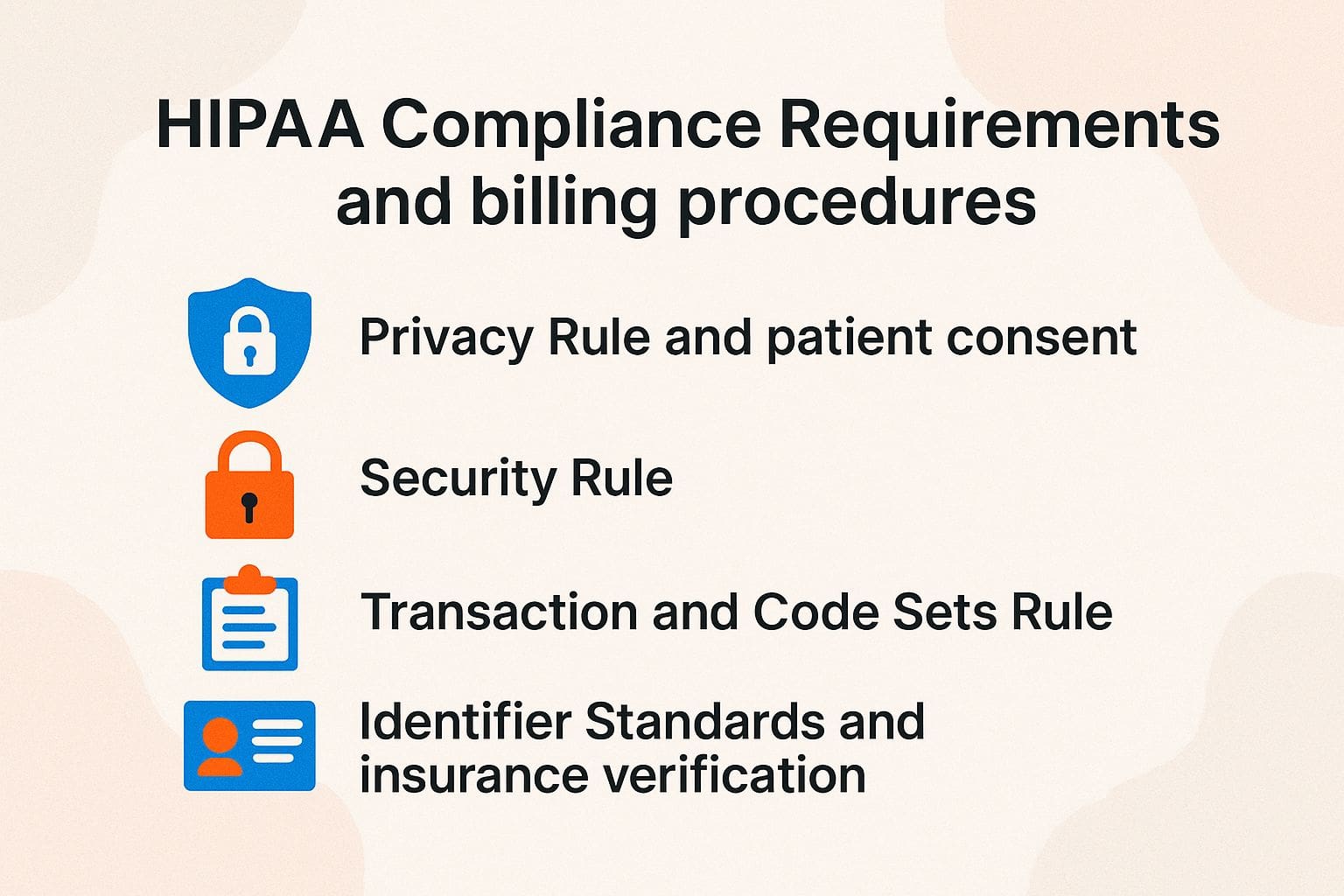
HIPAA compliance requires healthcare organizations to follow specific rules that protect patient data and keep it confidential.
Privacy Rule and Patient Consent
The HIPAA Privacy Rule establishes national standards for the protection of health information, granting patients rights over their data, ensuring patient rights.
Under this rule, patients have the right to access their medical records and request corrections to inaccuracies.
Healthcare providers need to get written permission from individuals before they share their health information to follow the rules. Not following the rules can lead to heavy penalties; for example, a company could be fined over $50,000 for each violation.
Breach can lead to loss of trust, legal actions, and even criminal charges. Regular staff training on patient rights and data handling is essential to meet these standards and prevent consequences.
Security Rule
The HIPAA Security Rule requires strong measures to protect electronic health information from being exposed, altered, or lost.
To comply with the HIPAA Security Rule, organizations should implement administrative, technical, and physical safeguards, addressing operational efficiency.
- First, evaluate potential risks to find weaknesses in your systems.
- Next, assign a Security Officer to oversee compliance and provide ongoing training for employees, establishing risk management protocols.
To protect your data, it’s important to encrypt it both when stored and during transfer. You might use BitLocker to encrypt disks or VPNs for secure connections.
Establish physical safeguards by controlling access to facilities where electronic health information is stored, using locks, key cards, or surveillance cameras.
Transaction and Code Sets Rule
The Transaction and Code Sets Rule makes electronic health care transactions uniform and guarantees correct coding for billing and handling claims, ensuring coding accuracy.
This rule mandates the use of specific code sets, such as the ICD-10 for diagnosing conditions and the CPT for procedure coding.
For example, when a patient learns they have diabetes, ICD-10 gives a specific code (E11 for type 2 diabetes) that makes billing easier and cuts down on mistakes.
Using software like Cerner or Epic can help healthcare providers follow regulations by automatically handling coding tasks and identifying errors instantly. These tools make the billing process more accurate and faster, while also allowing providers to understand how much medical billing software costs in 2025.
Identifier Standards and Insurance Verification
HIPAA created specific identification rules for healthcare providers, health plans, and employers to simplify transactions and make them work better.
These standards, including the National Provider Identifier (NPI), are essential for keeping transactions secure and correctly identified.
The NPI allows providers to be easily and uniquely identified across systems, reducing errors in billing and improving care coordination.
Healthcare organizations can use NPI to quickly check a provider’s qualifications and specialty, making it faster to submit claims and confirm eligibility.
Implementing these identifiers improves security, administrative efficiency, and patient outcomes, supporting healthcare analytics.
Compare Quotes
Implementing HIPAA-Compliant Medical Billing Services

Implementing medical billing services that meet HIPAA standards requires careful planning and choosing service providers who follow the rules, including third-party vendors.
Choosing the Right Billing Service Provider and Healthcare Technology
Selecting a billing service provider is critical; consider factors like HIPAA compliance, experience, and the range of services offered.
When evaluating providers, prioritize HIPAA compliance to safeguard patient information. Look into their background with billing in your field, as detailed knowledge can improve service quality.
Assess the variety of services they provide, such as claims management, patient billing, and reporting capabilities, considering integrated billing systems.
For example, some providers like AdvancedMD specialize in practice management while others like Kareo focus on billing software.
Before you decide, check how quickly the customer support responds to make sure they’re there to help you after you join.
Training Staff on HIPAA Compliance and audit trails
Effective HIPAA training is essential for all staff members to understand their responsibilities and the importance of protecting patient data.
To create a complete HIPAA training program, begin by concentrating on these main parts:
- understanding patient privacy
- recognizing the importance of consent
- knowing reporting procedures for breaches
Use platforms like Coursera for organized courses or HIPAA exams for evaluations, taking advantage of training programs.
Include real-life examples, like managing PHI in emails or during patient interactions, to help grasp practical use.
Take refresher courses twice a year and keep compliance documents updated to follow HIPAA rules.
Establishing Policies and Procedures and privacy practices
Having clear rules and processes is important for following the law; they need to be checked and revised often to match current rules, addressing data usage policies.
Key policies include Data Access Controls, which dictate who can view personal health information, and Incident Response Plans, outlining steps to take in case of a data breach while ensuring compliance with regulatory requirements.
Make sure your Data Access policy states that only approved staff can view patient records and has a system to record attempts to access these records.
Meanwhile, your Incident Response Plan should detail immediate actions, such as notifying affected individuals and reporting incidents to the Department of Health and Human Services within 60 days.
Regular compliance training on these policies is essential to stay compliant and fulfill legal requirements.
Compare Quotes
Technological Solutions for Data Security and Information Security
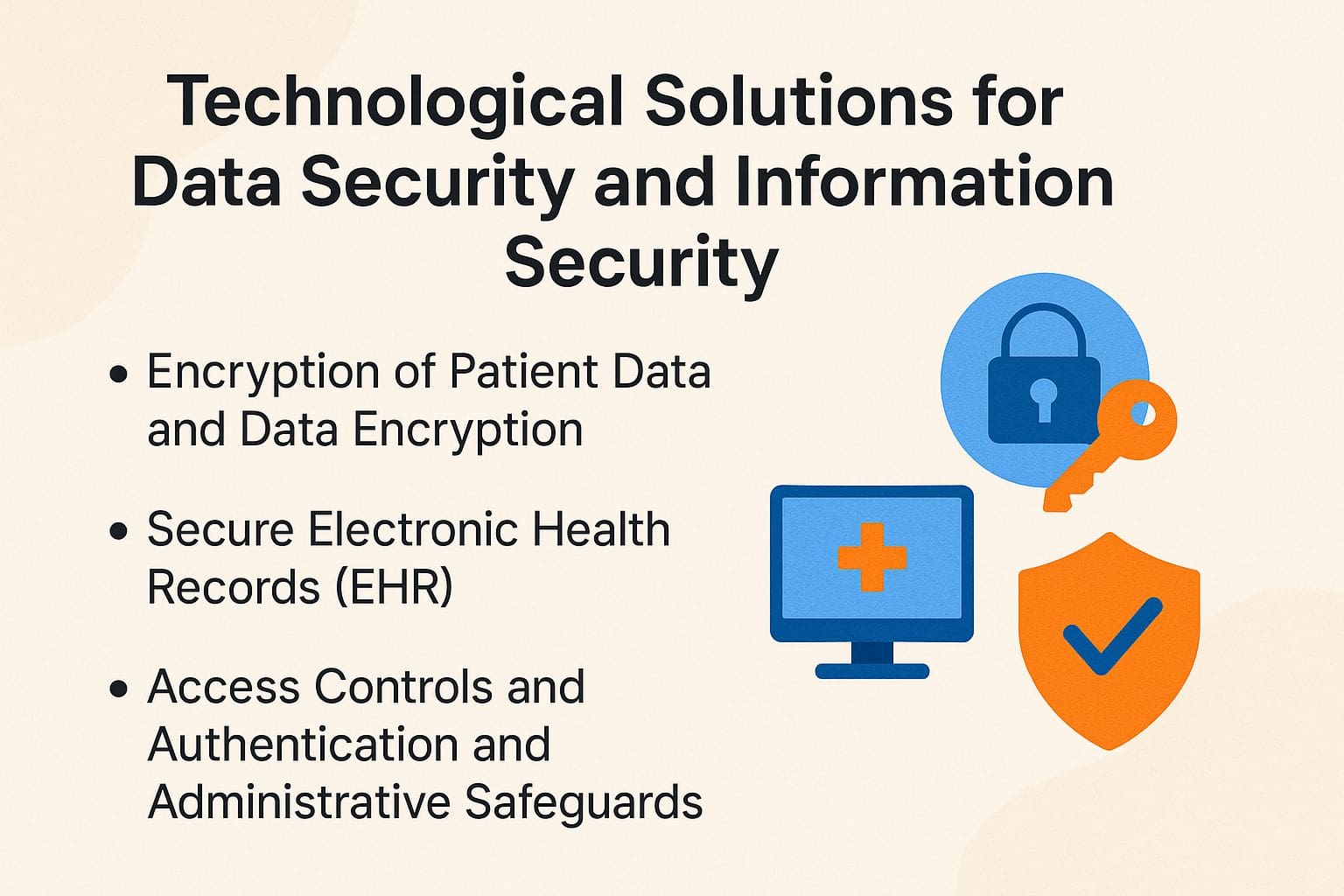
Using Health Information Technology is important for keeping patient information safe as required by HIPAA regulations and healthcare standards. As healthcare providers navigate these requirements, medical practice management software can offer significant benefits by streamlining the secure handling of patient data and improving operational efficiency.
Encryption of Patient Data and Data Encryption
Data encryption is a critical component of HIPAA compliance, protecting sensitive patient information from unauthorized access and maintaining data integrity.
Encrypting data in healthcare IT systems can be achieved through various methods, with AES-256 being one of the most reliable. This symmetric encryption method keeps data safe while it is being sent and stored.
For instance, Company X implemented AES-256 encryption on its electronic health records system, resulting in a significant reduction in data breaches. By regularly checking their encryption methods and training staff on security rules, they protected patient data and met HIPAA standards, which resulted in greater patient trust and satisfaction.
Secure Electronic Health Records (EHR)
Secure Electronic Health Records (EHR) systems are essential for protecting patient information and meeting HIPAA requirements.
To maintain the security of EHR systems, implement stringent access controls using tools like Okta for identity management.
Every three months, you should carry out regular security checks using services like Qualys for vulnerability scanning to maintain quality assurance.
Think about EHR providers such as Epic or Cerner, which offer solutions that comply with HIPAA and use strong encryption methods for secure storage.
Organize training sessions to educate employees on phishing and other security threats, ensuring data protection is thoroughly addressed.
Access Controls and Authentication and Administrative Safeguards
It’s important to have strong access controls and ways to verify user identity to protect patient data from unauthorized access.
Healthcare organizations can improve their security by using role-based access control (RBAC) and multi-factor authentication (MFA).
With RBAC, assign specific roles to employees, limiting their access strictly to the data necessary for their job functions. For instance, a billing clerk should only access financial records, not patient medical histories.
Implement MFA by requiring two forms of patient verification for accessing sensitive systems-this could be a password combined with a fingerprint scan or a one-time code sent to a mobile device.
Regularly check these controls to adjust to changing security needs.
Compare Quotes
Monitoring and Auditing for Compliance and Financial Compliance
Regular checks and reviews are important for ensuring HIPAA rules are followed and identifying possible weaknesses in data protection.
Regular Compliance Audits
Regular compliance audits help healthcare organizations find and fix issues with their HIPAA regulation adherence quickly, enhancing healthcare ethics and patient safety.
Try to carry out these audits at least once a year. It’s recommended to inspect high-risk areas every three months.
Key areas to assess include:
- Access controls
- Data encryption
- Employee training practices
Tools like Compliancy Group make tracking easier by offering templates for assessments and follow-up tasks, which makes documentation simpler.
To get the best outcomes, involve your compliance team in these audits to build a culture of responsibility and ongoing progress.
Making a checklist specific to your company’s tasks can help focus on details and keep consistent compliance management, protecting health data. When it comes to compliance, reviewing related regulations can also be beneficial, such as understanding how to stay compliant with labor laws as a new business owner.
Incident Reporting Procedures
Establishing clear incident reporting procedures is critical for timely response to potential HIPAA violations and data breaches.
Start by developing a step-by-step approach to document incidents effectively. First, create a standardized incident report template that captures essential details such as the date, time, nature of the incident, affected individuals, and immediate actions taken.
Next, set up rules for addressing incidents based on their seriousness-less serious issues might need to be looked at by the department, while major problems should be reported straightaway to top managers and legal advisors.
Think about setting up a logging system to monitor how each incident is handled, so you can have complete records and study them to prevent similar issues later, ensuring confidentiality agreements are followed.
**HIPAA-Compliant Medical and Telehealth Billing in the Coming Years**
Medical billing that complies with HIPAA will probably experience improvements in technology and changes in rules focused on improving data protection and reimbursement efficiency.
- One major trend is the integration of AI-driven solutions for automating billing processes. AI can make electronic claims submission easier by finding mistakes before they are sent, which lowers the chances of claim denials.
- Companies like Simplee and Zocdoc are improving patient billing platforms to make them clearer and easier to use. Starting to use these new ideas early will help you follow rules and make your operations run more smoothly.
- Staying informed about changes in regulations is important. Being ready for these updates is necessary for meeting rules and protecting patient data.
About The Author
Jordan Blake is a B2B strategist and contributor at Price It Here, where she shares expert advice on buying decisions and business growth. She holds a Bachelor’s in Business Administration from the University of Michigan and an MBA from Northwestern’s Kellogg School of Management.
With over a decade of experience in procurement and vendor strategy, Jordan helps businesses save money and scale smarter. Her practical insights make her a trusted voice for entrepreneurs seeking cost-effective, results-driven solutions.
