



POS System for Small Food Trucks: What You Need to Know
Benefits of Implementing a POS System

Adopting a POS like Lightspeed as a scalable solution slashes your food truck’s operational headaches, turning chaotic service into smooth 2-minute orders and cutting waste by 30%, as seen in a Portland burger truck’s case study.
Streamlined Order Processing and Speed
With Toast POS, you process orders 40% faster as a quick service restaurant solution, swiping cards and printing tickets via receipt printer in seconds instead of fumbling with cash, keeping lines under 5 minutes at peak lunch rushes.
To maximize this speed, follow these actionable steps:
- Use the touchscreen to enter orders in 10 seconds. Set up menus so you can tap popular items like tacos or burgers right away.
- Integrate with kitchen display systems (KDS) for instant order routing, eliminating paper tickets and reducing errors by 25% per Toast’s internal data.
- Enable split payments through the mobile app, allowing groups to pay individually without delays.
A Toast case study shows wait times dropping from 8 to 3 minutes, as seen in a Miami taco truck that scaled to 200 orders per day during rushes.
Improved Inventory Management
Clover POS tracks your burger buns in real-time, alerting you at 10% stock left to reorder via integrated suppliers, preventing the $200 weekly losses from overstocking perishables.
To implement this effectively, follow these three steps.
- First, during setup, scan all items using Clover’s built-in barcode reader to create a digital inventory database-takes about 30 minutes for 50+ products.
- Second, customize auto-alerts in the dashboard for low stock thresholds, like 20 units for buns, triggering instant supplier orders from partners like Sysco.
- Third, schedule weekly reports to analyze trends and adjust par levels.
According to Lightspeed’s 2022 report, such systems cut food waste by 35%. For instance, a Seattle food truck integrated Clover with Sysco, saving 15 hours monthly on manual checks.
Better Customer Service and Loyalty
You build repeat business with Square’s loyalty app, where customers scan QR codes for 10% off after 5 visits, turning one-time festival buyers into weekly regulars.
Improve the system by adding digital punch cards and gift cards directly in the app to increase customer loyalty.
No physical cards are needed, and it makes tracking visits easy with CRM tools.
Link your email to send offers that match customers’ past orders, using Square’s features for social media marketing to handle the sending.
Track customer preferences, such as favorite menu items, to speed up service and build rapport.
A 2021 Harvard Business Review study found that loyalty programs increase customer retention by 28%.
For instance, an Austin BBQ truck gained 300 loyalty members in six months by customizing rewards to local tastes.
Financial Tracking and Reporting Advantages
Revel Systems creates daily profit reports with sales reporting and sales analytics that show $1,200 in net profit from selling 150 tacos. It connects with accounting software like QuickBooks to handle tax calculations and tax filings automatically and find times of highest sales.
Food truck owners can apply this information by dividing financial management into specific steps.
- First, export sales data to CSV format for advanced Excel analysis, where you can apply formulas to forecast monthly profits or categorize expenses like ingredients and fuel.
- Second, use the built-in dashboards to review hourly breakdowns, revealing patterns such as 60% of sales during 12-2 PM rushes.
- Third, enable automatic calculations for tips and discounts, which adjust net figures in real-time to comply with IRS guidelines on food truck deductions (Publication 463).
For instance, a Chicago vendor reduced accounting time from 10 to 2 hours weekly, streamlining operations and boosting efficiency.
Compare Quotes
Essential Features for Food Truck POS
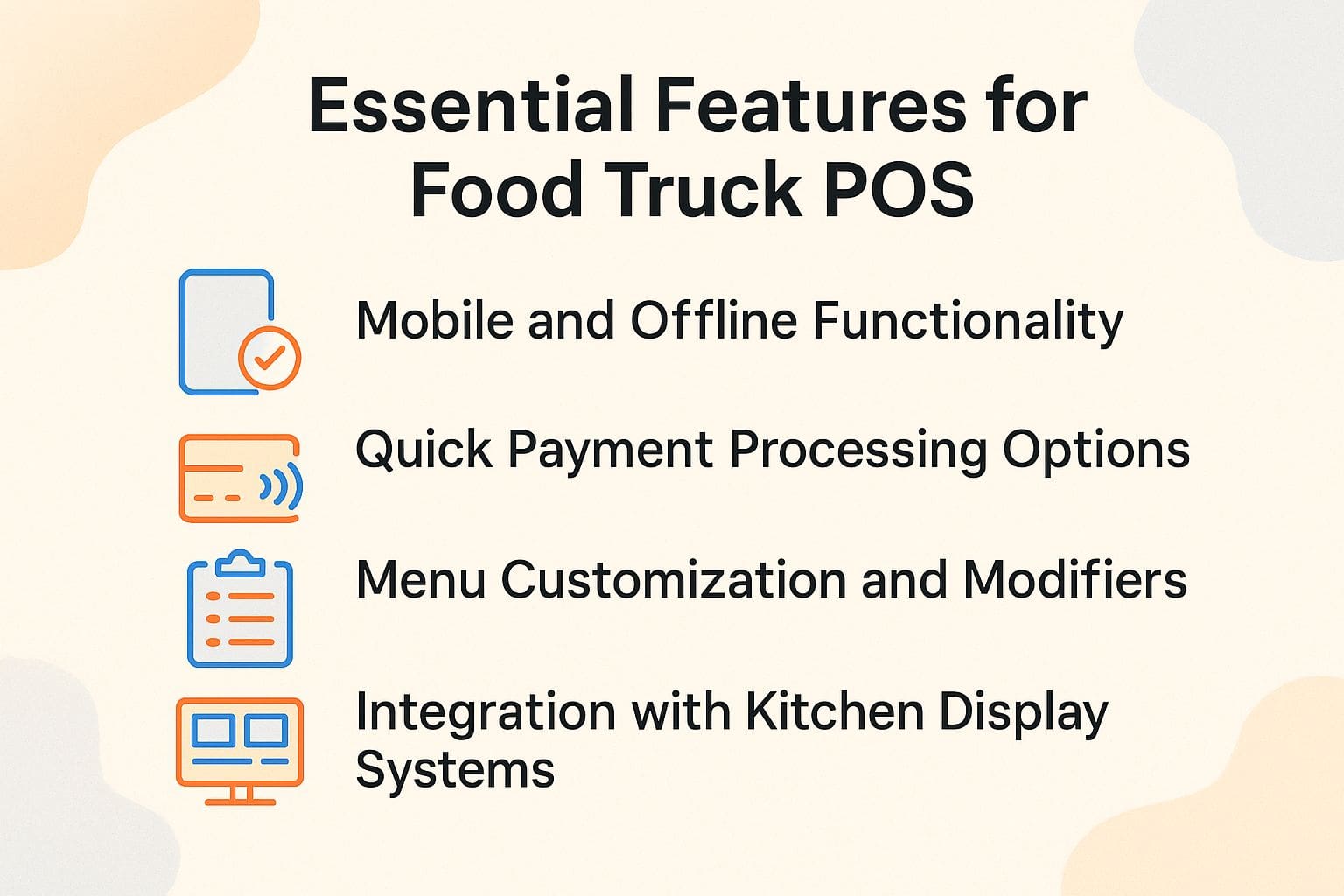
Your food truck demands POS features like offline mode in Square, quick EMV chip reads, and hardware components-key elements highlighted in our review of the best POS systems for small businesses-ensuring you serve 100 customers uninterrupted even at remote markets.
Mobile and Offline Functionality
Lightspeed’s app as a software platform lets you take orders via iPad offline with wireless connectivity, syncing 200 transactions once back online, perfect for your truck’s festival gigs without Wi-Fi.
To get started, follow these simple setup steps:
- Download the Lightspeed Retail app from the App Store or Google Play on your iPad or Android device.
- Log in and enable offline mode in the settings menu under ‘Advanced Options’ to process payments securely without internet.
- When you’re back in range, sync data automatically via Wi-Fi or 4G-ensuring all orders upload without manual intervention.
This setup handles up to 500 offline sales per day, preventing revenue loss during outages.
For instance, an Orlando food truck used it during hurricanes, syncing seamlessly without data loss.
It adheres to PCI DSS compliance for encrypted data storage with fraud protection, eliminating payment overlap risks.
Quick Payment Processing Options
Clover’s Bluetooth reader with Bluetooth pairing accepts Apple Pay in 3 seconds, processing $5,000 daily without cables, ideal for your high-volume lunch line in mobile commerce.
To maximize efficiency, integrate these payment options seamlessly.
- enable EMV chip and magstripe swipes using the portable reader ($49 add-on), securing transactions for cards like Visa or Mastercard.
- activate contactless NFC for 80% faster taps-ideal for quick lunch rushes, supporting Apple Pay, Google Pay, and Samsung Pay.
- use split payments for group orders, dividing bills instantly via the app.
Fees average 2.6% + 10c per tap (per Visa rates).
A LA vegan food truck added Google Pay support, boosting sales 15% by reducing checkout times in the checkout system, per Clover case studies and user reviews.
Menu Customization and Modifiers
Toast allows you to add ‘extra cheese’ modifiers on-the-fly with menu management, updating pricing updates instantly for 50 custom burger orders without reprinting menus.
- To maximize this feature for complex menus, build your items in the Toast app by adding up to 10 modifiers per dish, such as spice levels from mild to extra hot or toppings like avocado and bacon.
- Next, set up auto-pricing rules. For example, add $1.50 for premium add-ons. This makes calculations run without issues.
- Test the setup across 100 menu items to verify accuracy.
This approach reduces order errors by 40%, per Toast’s internal efficiency reports. For instance, a fusion food truck customized 20 vegan options this way, boosting upsells by 25% during peak hours.
Integration with Kitchen Display Systems
For seamless operations, integrate KDS with cash drawer for secure cash handling and support multi-location support if expanding to pop-up shops or event catering.
Features such as AI suggestions for menus, voice ordering without hands, and self-service choices can improve queue management.
Use predictions for inventory and demand to adjust for seasons. This cuts waste and raises profit margins.
For street vending and mobile commerce, use GPS to track fleets and connect vehicles to power systems that provide solar charging, backup power, and surge protection.
Minimize downtime with maintenance plans and upgrade paths, while offering customer support, training resources, implementation guide, troubleshooting guides, and multilingual support.
Look at the cost details, return on investment calculations, system comparisons, subscription plans, one-time payments, and industry directions to stay ready for the long term.
Include employee management, time tracking, vendor integration, custom reports, accessibility options, food safety tracking, allergen alerts, sustainability tools, eco-friendly materials, digital receipts, and carbon footprint reduction through sustainable practices.
Square syncs your iPad orders to a $200 kitchen tablet, displaying ‘2 tacos, no onions’ in seconds, cutting misfires from 15% to 2%.
To implement this, follow these actionable setup steps:
- Connect the iPad and kitchen tablet via Wi-Fi or Bluetooth in under 5 minutes using Square’s dashboard.
- Map order fields-like modifiers and allergens-to the tablet display for clear, customizable views.
- Train staff in a 30-minute session to interpret and act on real-time updates.
For example, a BBQ truck integrated this for 300 orders per day, saving 1 hour per shift on order handling.
This matches FDA rules for correct food orders to avoid safety problems, which cuts allergy risks by making sure communication is clear.
Compare Quotes
Hardware Requirements for Small Food Trucks
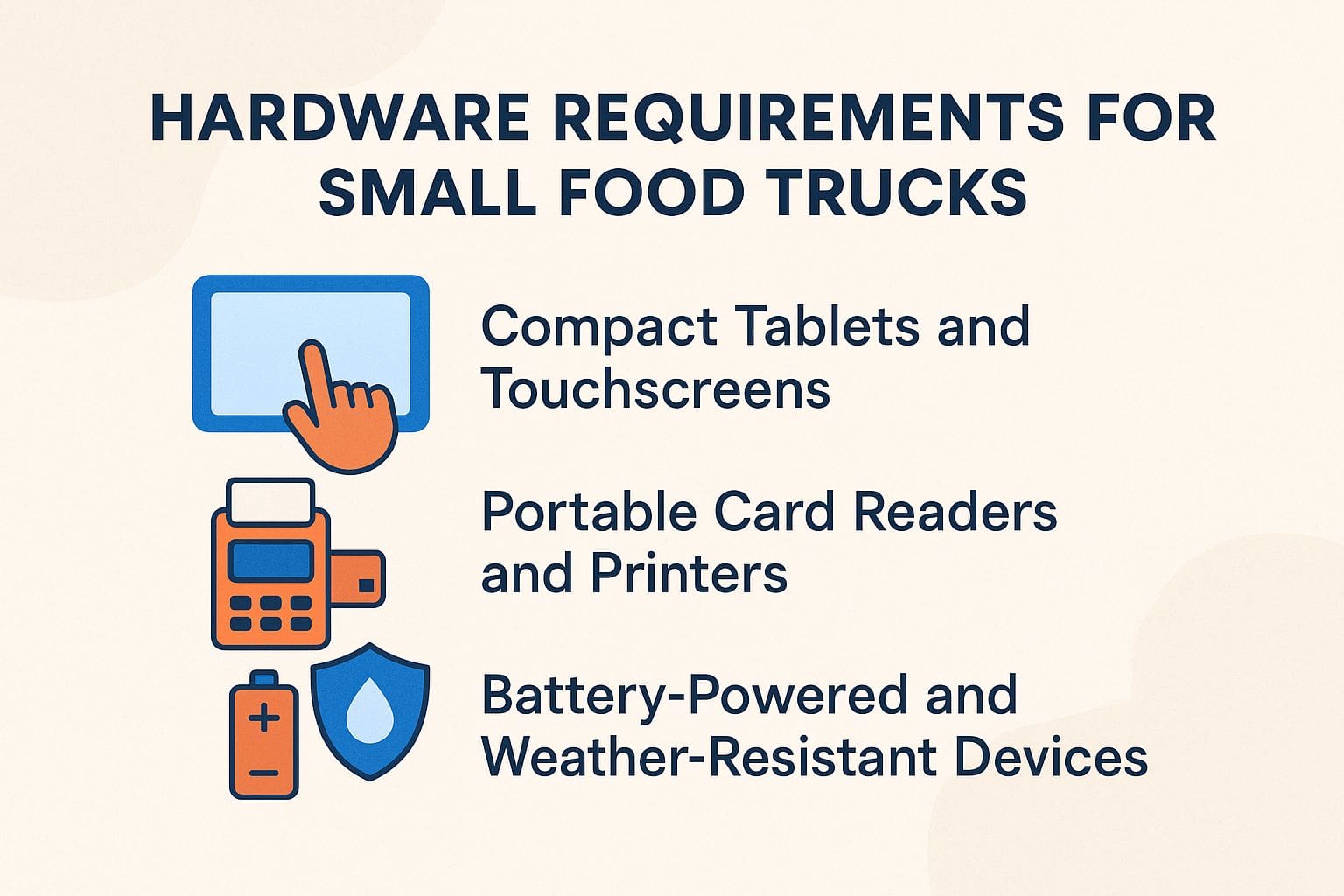
Equip your food truck with rugged hardware like an iPad Pro ($800) and Star Micronics printer ($300), built for 8-hour shifts in rain or heat.
Compact Tablets and Touchscreens
Opt for a 10-inch Samsung Galaxy Tab A ($250) as your touchscreen, mounting it magnetically for quick access in your 6ft counter space.
This Android tablet offers 4GB RAM, sufficient for processing up to 200 orders smoothly without glitches, as seen in an ice cream truck setup that ran 12-hour shifts flawlessly.
For Clover POS integration, consider the iPad Mini (7.9-inch, $400) instead, which provides seamless app compatibility in tighter spaces.
Other Android tablets under $300 include the Lenovo Tab M10 ($220) for its colorful display.
Always add a rugged protective case ($50) like OtterBox to shield against spills and drops, ensuring longevity in busy environments.
Portable Card Readers and Printers
Pair Square’s $49 magstripe reader with a Bixolon portable printer ($200) for wireless receipts, clipping to your belt for on-the-go swipes.
Switch to an EMV reader like Square’s contactless model for improved security and faster transactions.
It meets PCI DSS certification from EMVCo standards and supports chip-and-PIN cards to lower fraud chances. Federal Reserve research shows EMV reduces counterfeit fraud by 87%.
The Bixolon’s Bluetooth connectivity supports up to 300 receipts per battery charge, ideal for mobile vendors. Add a $100 barcode scanner attachment for quick inventory tracking.
A pizza truck operator reported printing 150 tickets daily without downtime, boosting sales by 20% through seamless transactions.
Battery-Powered and Weather-Resistant Devices
Your Revel-compatible Anker power bank ($30) extends iPad battery to 15 hours, while IP67-rated cases ($40) shield against 2-inch rains at outdoor events.
For demanding field work, opt for devices featuring 10,000mAh batteries to power through full 12-hour shifts without recharging.
Get MIL-STD-810G certification. It checks for drops, vibrations, and very high or low temperatures.
For example, the OtterBox Defender series was in a truck on the coast during Hurricane Ian and handled hurricane-force winds without losing any data.
Integrate GPS tracking via apps like Find My Device for real-time location monitoring. Gartner’s 2022 report states that these rugged systems increase uptime by 30% in bad weather, which reduces downtime for logistics teams.
Pair with weather-sealed cables to maintain connections in rain or dust storms.
Compare Quotes
Software Considerations and Top Providers
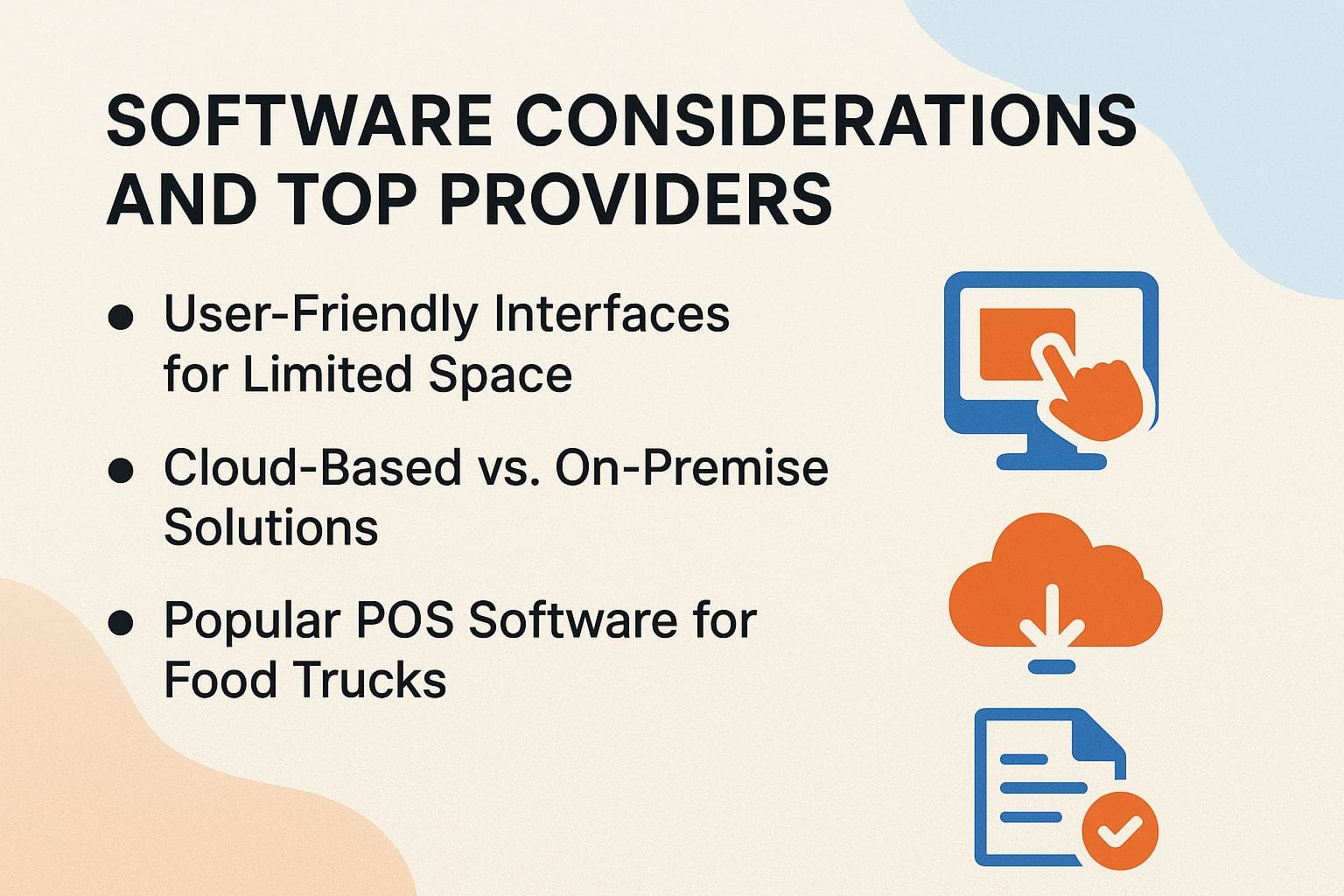
Choose software like Toast ($75/mo) that runs on your existing tablet, offering food truck-specific tools without heavy IT needs.
User-Friendly Interfaces for Limited Space
Lightspeed’s one-tap dashboard fits your tiny counter, letting you enter orders with 5 icons instead of scrolling menus on a 10-inch screen.
This setup streamlines operations for small food businesses with three standout features.
- First, customizable icons let you resize visuals for gloved hands, ensuring quick taps during prep rushes.
- Second, built-in voice commands allow hands-free order entry, ideal for multitasking staff.
- Third, the app’s 20-minute tutorials provide step-by-step training- a falafel truck owner, for example, onboarded two employees in just 15 minutes, slashing order errors by 25%.
To implement, download the app, customize icons via the settings menu, and run the tutorial module for immediate efficiency gains.
Cloud-Based vs. On-Premise Solutions
Go cloud with Square for auto-backups across locations, versus on-premise Revel for full offline control, each suiting your truck’s Wi-Fi variability.
Square’s cloud platform offers real-time inventory syncing across multiple trucks for just $0 upfront plus 2.6% + $0.10 per transaction, ideal if you operate in urban areas with consistent Wi-Fi.
Set it up in under an hour via their app, enabling auto-backups to prevent data loss during peak hours.
Conversely, Revel’s on-premise system costs $99/month per terminal with offline mode, storing sales locally on a tablet-perfect for remote routes.
Actionable tip: Test Wi-Fi reliability with a 7-day Square trial before committing; for hybrids, consider Toast’s local cache feature, as per PCI DSS standards for secure payments.
This ensures compliance without service interruptions.
Popular POS Software for Food Trucks
Top picks include Square (free software, 2.6% fees) for starters, Toast ($69/mo) for kitchen integrations, and Clover ($14.95/mo) for custom apps.
| Provider | Starting Price | Key Features | Best For | Pros/Cons |
|---|---|---|---|---|
| Square | Free software, 2.6% fees | Mobile app, inventory tracking, quick payments | Solo food trucks | Pros: Easy setup; Cons: Limited reporting |
| Toast | $69/mo | Kitchen display, online ordering, analytics | Team-based restaurants | Pros: Reliable connections to other systems; Cons: More expensive |
| Clover | $14.95/mo | Custom apps, hardware flexibility, loyalty programs | Customizable setups | Pros: Versatile; Cons: App fees add up |
| Lightspeed | $69/mo | Multi-location support, e-commerce, staff management | Growing chains | Pros: Scalable; Cons: Steep learning curve |
| Revel | $99/mo | Cloud-based, real-time reporting, third-party integrations | High-volume operations | Pros: Reliable uptime; Cons: Expensive hardware |
Square vs. Toast: Square is easier for solo trucks with a 5-minute setup, ideal for quick mobile payments without monthly fees. Toast suits teams better, offering kitchen integrations but with a 1-hour learning curve for full features.
Both earn strong reviews, averaging 4.5/5 on Capterra for reliability and support.
Compare Quotes
Cost Factors and Budgeting
Budget $600-1,500 for your food truck POS startup, covering a $300 tablet and $50/mo software, with ROI in 2-4 months via 20% sales lift. For an extensive analysis of hardware costs like these tablets often used in POS setups, our comprehensive guide to interactive kiosk pricing in 2025 breaks down key factors.
Initial Setup and Hardware Costs
Your initial outlay hits $800: $599 iPad, $49 Square reader, $150 printer, plus 2-hour setup time using guided apps.
To get started, follow these numbered steps for a seamless mobile POS setup using Square’s ecosystem.
- Buy the Square Starter Kit bundle for $300 total. It includes the reader, stand, and charger. This makes hardware easier to handle.
- Download the free Square Point of Sale app on your iPad (installation takes 10 minutes).
- Configure your item menu via the app’s intuitive dashboard (about 1 hour, including tax and tip settings).
- Test transactions with a sample sale, ensuring Bluetooth pairing with the printer (30 minutes).
Total setup: 3 hours. Avoid pitfalls like skipping PCI compliance-fines can reach $100,000 per violation, per PCI Security Standards Council guidelines.
For example, Budget Truck Rentals launched a similar system for $450, boosting efficiency by 40% according to their 2022 case study.
Ongoing Fees and Subscription Models
Expect $50-100 monthly from Toast’s basic plan plus 2.5% per transaction on $10,000 sales, totaling $350/year beyond hardware.
In contrast, Square offers a free basic subscription with 2.6% + $0.10 per transaction, while Clover starts at $15/month but drops fees to 2.3% with volume.
Factor in maintenance add-ons, around $100/year for updates across providers.
For a vendor processing 1,000 transactions monthly at $10 average, total costs hit about $250 annually for Square-cheaper than Toast’s $1,000-plus.
Calculate ROI by estimating $500/month labor savings from automation, yielding a 6-month payback per a 2023 National Restaurant Association study.
Premium tiers include 24/7 support for high-volume users, ensuring uptime and compliance.
About The Author
Jordan Blake is a B2B strategist and contributor at Price It Here, where she shares expert advice on buying decisions and business growth. She holds a Bachelor’s in Business Administration from the University of Michigan and an MBA from Northwestern’s Kellogg School of Management.
With over a decade of experience in procurement and vendor strategy, Jordan helps businesses save money and scale smarter. Her practical insights make her a trusted voice for entrepreneurs seeking cost-effective, results-driven solutions.
