



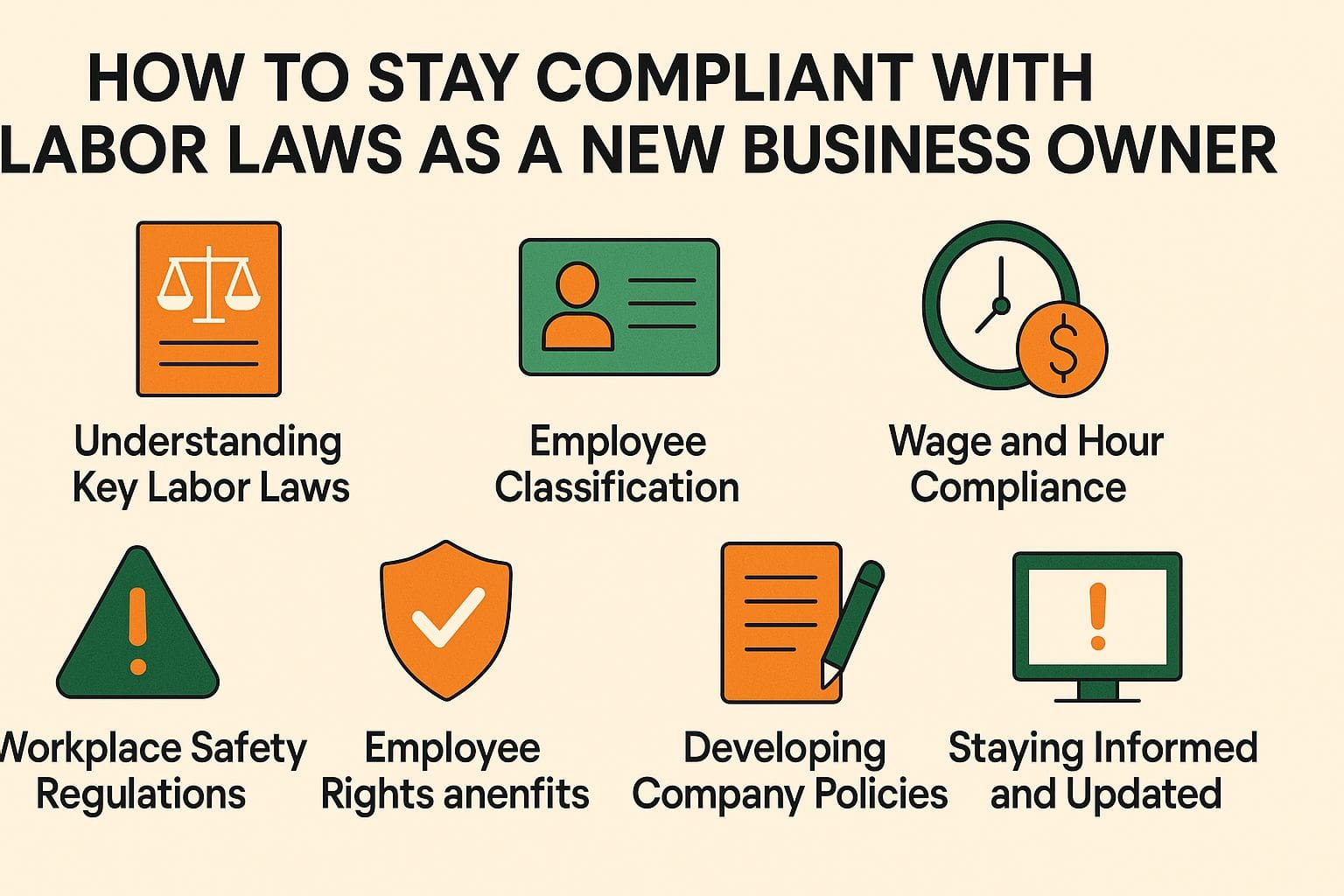
How to Stay Compliant with Labor Laws as a New Business Owner
Starting a new business is thrilling, but it also comes with a maze of labor laws and employment regulations that demand attention. New business owners need to know and follow these rules to avoid expensive fines and create a good workplace. This guide covers important labor laws, employee roles, meeting wage rules, managing benefits, and why a safe workplace matters. Are you prepared to understand the details of labor law compliance? Let’s get into the details and help your business succeed while following legal requirements.
Importance of Compliance for New Business Owners
Compliance with labor laws is essential for safeguarding employee rights and meeting legal obligations.
Knowing the rules can help a new business owner avoid lawsuits that might cost $100,000 or more.
Failing to adhere to labor laws can result in significant penalties. For example, a startup in California faced a $150,000 fine after misclassifying employees as independent contractors. Ensuring proper worker classification is critical for compliance.
The average legal costs for such cases may exceed $20,000, not including settlements. Regular audits and consultations with legal counsel can further safeguard against costly litigations.
It’s important to often check the labor laws that apply to your state and industry.
Platforms for handling HR tasks and legal compliance checklists can help in following regulations. Regular audits and consultations with labor law specialists can further safeguard against costly litigations.
Overview of Labor Laws
Labor laws include rules about pay, safety at work, and worker rights, which all new businesses need to know.
Key categories of labor laws include the Fair Labor Standards Act (FLSA), which sets minimum wage and overtime pay requirements; the Occupational Safety and Health Administration (OSHA), which mandates workplace safety standards; and Equal Employment Opportunity (EEO) laws, ensuring workplace discrimination protections.
For instance, FLSA mandates that non-exempt employees earn at least the federal minimum wage and receive time-and-a-half for overtime hours worked. Meanwhile, OSHA regulations require businesses to maintain safe working environments, which can include regular safety audits and employee training programs.
Learning these laws is important for following the rules and creating a fair work environment. If interested, businesses can further explore how these laws integrate with payroll systems through our guide on Kronos Payroll System.
Understanding Key Labor Laws
Knowing important labor laws is necessary for following regulations and treating employees fairly.
Knowing labor laws is important for businesses to comply with regulations and safeguard employee rights.

Fair Labor Standards Act (FLSA)
The Fair Labor Standards Act (FLSA) establishes minimum wage, overtime pay, and youth employment standards, impacting millions of employees across various sectors.
The FLSA establishes minimum wage, overtime pay, and youth employment standards, impacting millions of employees across various sectors.
Employers are required by federal law to pay at least $7.25 per hour, but some states have set higher minimum wages. Compliance with state employment laws is also necessary.
To meet compliance, businesses can use payroll management tools like Gusto, which automatically calculate overtime pay (1.5 times the usual rate for hours over 40 in a week) and keep employee records.
Implementing regular training sessions for management on FLSA requirements can help minimize violations. Employee training on these regulations is equally important.
For example, establishing clear guidelines on youth employment restrictions protects younger workers while keeping the company in line with labor laws.
Occupational Safety and Health Administration (OSHA) Regulations
OSHA rules require businesses to keep work areas safe and healthy.
OSHA rules are created to make work areas safe. Serious violations can lead to fines of over $13,000.
To comply with OSHA standards, businesses should implement regular safety training sessions. Use resources like SafetySkills or OSHA’s training material to improve employee knowledge about certain safety rules.
Organize these sessions every three months and evaluate how well employees understand the material using tests or practical exercises. Maintaining a well-documented safety plan can help identify potential hazards and demonstrate commitment during inspections.
It’s important to regularly check and update your safety rules because laws change and your workplace can change too. Frequent compliance training keeps everyone updated on the newest safety rules.
Family and Medical Leave Act (FMLA)
The Family and Medical Leave Act (FMLA) allows eligible employees to take up to 12 weeks of unpaid leave for family and medical reasons, protecting their job security.
The FMLA allows eligible employees to take up to 12 weeks of unpaid leave for family and medical reasons, protecting their job security.
To qualify for FMLA, an employee must work for a covered employer with at least 50 employees within a 75-mile radius, have worked for at least 1,250 hours over the previous 12 months, and have a qualifying reason for leave, such as a serious health condition or caring for a newborn. Proper documentation and recordkeeping are essential for compliance.
It’s important to keep documents such as FMLA request forms and medical certification templates to meet legal requirements. Tools like Gusto or Zenefits offer FMLA documentation templates that simplify this process and help track employee leave effectively.
Equal Employment Opportunity (EEO) Laws
Equal Employment Opportunity (EEO) laws prohibit discrimination based on race, gender, religion, and other characteristics, promoting fairness in hiring practices.
EEO laws prohibit discrimination based on race, gender, religion, and other characteristics, promoting fairness in hiring practices.
These laws require employers to adopt inclusive hiring practices, such as standardized interview questions and diverse candidate pools.
To improve compliance, organizations can set up thorough training programs for HR staff. Fair hiring practices and strong workplace rules are needed to comply with EEO laws.
For example, getting HR certifications like SHRM-CP or HRCI’s PHR provides staff with information about EEO regulations and promotes a culture of diversity.
Businesses should frequently check their workplace rules to make sure they follow EEO standards, creating a setting that promotes fairness and equal treatment for all workers.
Employee Classification
Properly classifying employees is essential for following tax and labor laws. It affects how payroll is handled and how benefits are managed.
Properly identifying workers as either employees or independent contractors is important to follow tax and labor laws.

Distinguishing Between Employees and Independent Contractors
The IRS provides a 20-factor test to determine if a worker is an employee or independent contractor, affecting tax and benefit obligations. Misclassification can lead to significant penalties and affect employee rights.
Key factors include:
- control over work, where the employer dictates how tasks are performed;
- financial aspects, such as whether the worker has unreimbursed expenses or profits;
- the nature of the relationship, through written contracts or benefits.
Misclassification can lead to significant penalties, including back taxes and unpaid benefits. To properly classify workers, maintain detailed records, use clear contracts, and check worker roles often against IRS rules to reduce risks.
Implications of Misclassification
Misclassifying employees can lead to hefty penalties, back taxes, and loss of benefits, costing businesses thousands. It’s essential to follow proper classification practices to avoid legal risks.
For instance, the case of the delivery service in California highlighted a misclassification risk, resulting in a $2 million fine.
To prevent problems, you should use tools like QuickBooks to manage payroll and correctly classify workers as either employees or independent contractors. Regular audits and employee classification reviews can also aid in compliance.
Consider consulting legal experts if you’re uncertain, as the financial and legal ramifications can escalate quickly without proper guidance.
Wage and Hour Compliance
Rules about pay and work hours determine how workers should be compensated, ensuring companies pay their employees justly.

Minimum Wage Requirements
Knowing and following the minimum wage rules is essential for meeting payroll laws and steering clear of fines.
As of 2023, the federal minimum wage is $7.25 per hour, but many states have enacted higher rates averaging $15/hour.
To comply with state laws, you need to know the minimum wage rates for your area.
Tools like Paycor offer payroll solutions that automatically update with the latest state and local wage laws. For example, if you are in California where the minimum wage is $15.50, Paycor will make sure all employee wages are at least that amount.
Regularly consulting state labor department websites can help clarify any local amendments, ensuring your payroll practices are always up to date.
Overtime Pay Regulations
Overtime pay regulations, as stipulated by the FLSA, require non-exempt employees to receive 1.5 times their regular pay for hours worked over 40 in a workweek.
Under FLSA, non-exempt employees must receive 1.5 times their regular pay for hours worked over 40 in a workweek.
To calculate overtime pay, first determine the employee’s regular hourly rate. For example, if an employee earns $20 hourly, their overtime rate is $30 ($20 x 1.5).
To accurately record hours, tools like TSheets can be very useful. With TSheets, managers can monitor hours in real-time, keeping records that support compliance audits.
Make sure you accurately classify employees; errors in classification can lead to costly issues. Adopting a clear policy and regularly training your staff on the FLSA guidelines can help prevent common pitfalls.
Workplace Safety Regulations
Adhering to workplace safety regulations is essential for promoting a safe work environment and reducing risks.
Following workplace safety rules is not just legally required; it promotes a safe environment for employees.
Creating a Safe Work Environment
Implementing safety programs can reduce workplace injuries by up to 40%, saving businesses on healthcare costs and lost productivity. Regular safety audits are essential for following health and safety rules.
To keep the workplace safe, start by regularly inspecting for potential hazards. Use tools like SafetyCulture for easier reporting and audit management.
Next, create detailed training programs specific to each job, so that all employees know the best methods and emergency procedures. Schedule these training sessions at least quarterly to keep safety top-of-mind.
Promote a culture of reporting by establishing an anonymous feedback system, encouraging staff to voice concerns without fear of repercussions. This proactive approach raises safety awareness and encourages employee participation.
Reporting and Recordkeeping Requirements
Employers must maintain records of workplace injuries and illnesses as required by OSHA to comply with federal regulations and minimize legal risks.
Employers must maintain records of workplace injuries and illnesses, as required by OSHA, to comply with federal regulations.
To comply with regulations, employers need to use tools such as the OSHA 300 Log to record each incident, and the OSHA 301 Incident Report to explain each case in detail.
Many companies use software like OSHA Compliance Wizard or SafetySync to simplify reporting and maintain organized records. Regular checks of these logs improve accuracy and prepare for inspections.
It’s best practice to review logs quarterly, adjusting reporting methods as needed to improve data integrity, workplace compliance, and employee safety measures.
Employee Rights and Benefits
Knowing employee rights is important for creating a fair workplace where everyone can succeed.
Employee Rights and Duties
Employees have rights to fair treatment, safe work environments, and non-discrimination, which must be upheld by employers under anti-discrimination laws.
Employees are entitled to file complaints regarding workplace violations without fear of retaliation. You can learn about these rights by using resources like the U.S. Department of Labor’s website, where you can find information about workplace safety rules and employee benefits.
Local labor offices help with problems such as unpaid wages or discrimination. Employees should actively maintain notes of their issues and talk to HR or a dependable supervisor to safeguard their rights.
Providing Required Benefits
Federal employment laws mandate certain benefits such as health insurance, paid leave, and retirement plans for eligible employees.
To manage these employee benefits well, employers can use platforms like Gusto and Zenefits.
Gusto makes payroll easy and handles compliance with labor laws, so you can provide health insurance and retirement plans without hassle. Unlike others, Zenefits offers a complete set of tools for managing benefits, enabling employees to handle tasks themselves and receive immediate updates on compliance.
Both tools help businesses simplify their HR tasks, ensuring all employees receive their benefits, such as workers’ compensation and unemployment insurance, without a lot of manual work.
Developing Company Policies
Setting clear rules for the company is important to define expected behavior, ethical standards, and following workplace guidelines.

Drafting an Employee Handbook and Job Descriptions
A good employee handbook should cover important rules about behavior, benefits, employee rights, and labor unions, customized to fit your company’s requirements.
Start by outlining essential sections such as:
- “Company Mission and Values”
- “Code of Conduct”
- “Compensation and Benefits”
- “Employee Rights and Responsibilities.”
Use simple and inclusive words so everyone can easily read and follow the employee handbook. Tools like Zenefits offer customizable templates that can simplify the drafting process.
Allocate time for reviewing and revising the handbook with relevant stakeholders. Collaborating improves accuracy and holds employees responsible, making sure the final product meets legal requirements and matches the organization’s values.
Implementing Anti-Discrimination and Diversity Policies
Putting in place detailed anti-discrimination rules is important for building a welcoming work environment and preventing legal problems.
To achieve this, organizations should establish thorough training programs, ensuring all employees understand anti-discrimination laws and workplace expectations.
Google conducts yearly workshops on unconscious bias to create an environment where everyone feels accepted and included.
It’s important to have a strong system for reporting workplace harassment.
It needs to let employees share incidents privately. The Equal Employment Opportunity Commission (EEOC) suggests using an anonymous hotline to encourage reporting.
Companies like Starbucks have successfully implemented such systems, significantly reducing incidents of discrimination while promoting transparency and trust among staff.
Staying Informed and Updated
Keeping up with changes in labor laws, including EEOC regulations, is important for businesses to follow rules and adjust to new regulations.
Resources for Labor Law Updates
Utilizing resources such as the U.S. Department of Labor website, local chambers of commerce, and HR legal counsel can help businesses stay compliant with workplace compliance standards.
Plus these resources, consider subscribing to industry newsletters like the Society for Human Resource Management (SHRM) or the Employment Law Alliance. These platforms offer regular updates on changes in labor laws and best practices.
Using legal tools like Lexology can give you specific information related to your industry. Participating in local HR networking groups can facilitate discussions on compliance challenges and solutions, keeping your business informed and prepared for changes.
About The Author
Jordan Blake is a B2B strategist and contributor at Price It Here, where she shares expert advice on buying decisions and business growth. She holds a Bachelor’s in Business Administration from the University of Michigan and an MBA from Northwestern’s Kellogg School of Management.
With over a decade of experience in procurement and vendor strategy, Jordan helps businesses save money and scale smarter. Her practical insights make her a trusted voice for entrepreneurs seeking cost-effective, results-driven solutions.
