



Top 9 Credit Card Processors: Fastest Ways to Pay and Get Paid
Choosing the right credit card processor can make or break your business. With countless options available, how do you find the one that fits your needs? Choosing the right processor increases your sales and makes your transactions more efficient. In this guide, you will look at the best nine credit card processors, find out important details like transaction fees and processing speed, and understand how to choose the best option for your needs. Prepare for quicker payments and effortless transactions!
What is Credit Card Processing?
Credit card processing includes a series of actions allowing businesses to accept payments from customers safely and quickly.
The process starts when a customer swipes their card, which triggers the request for authorization through a payment gateway like PayPal, Stripe, or Square.
Next, the gateway forwards this request to the card issuer for approval. Once authorized, the transaction moves into the settlement phase, where the funds are captured and transferred to the merchant’s account through efficient business payments.
The payments are reconciled, ensuring that the merchant receives the correct amount, ensuring secure transactions and proper payment reconciliation.
Using tools like a flowchart can show this process with many steps, making it easier to understand and manage, thus improving user experience and reducing operational costs.
Importance of Choosing the Right Processor
Selecting the right credit card processor can significantly affect your business’s cash flow, customer experience, overall profitability, and business efficiency through effective cash flow management.
For instance, processors like Square offer flat-rate fees and quick transaction times, enhancing customer satisfaction. In contrast, PayPal, while widely recognized, often has longer processing times, which can lead to transaction abandonment-statistics show that 30% of customers abandon a purchase due to slow payment processes affecting sales conversion.
If your business has a high volume of transactions, processors with tiered pricing like Stripe may be more cost-effective in the long run. Evaluate the specific needs of your business to determine the best fit for your merchant services and payment methods. For a deeper understanding of how these fees can impact your business, see also: The Ultimate Guide to Credit Card Processing Fees and Costs.
Criteria for Selecting a Credit Card Processor
When choosing a credit card processor, consider important factors that can help you make a decision for the best performance and cost savings. Selecting the right processor can vastly impact your business efficiency and expenses, as explored in our expert opinion on the best credit card processors for businesses.
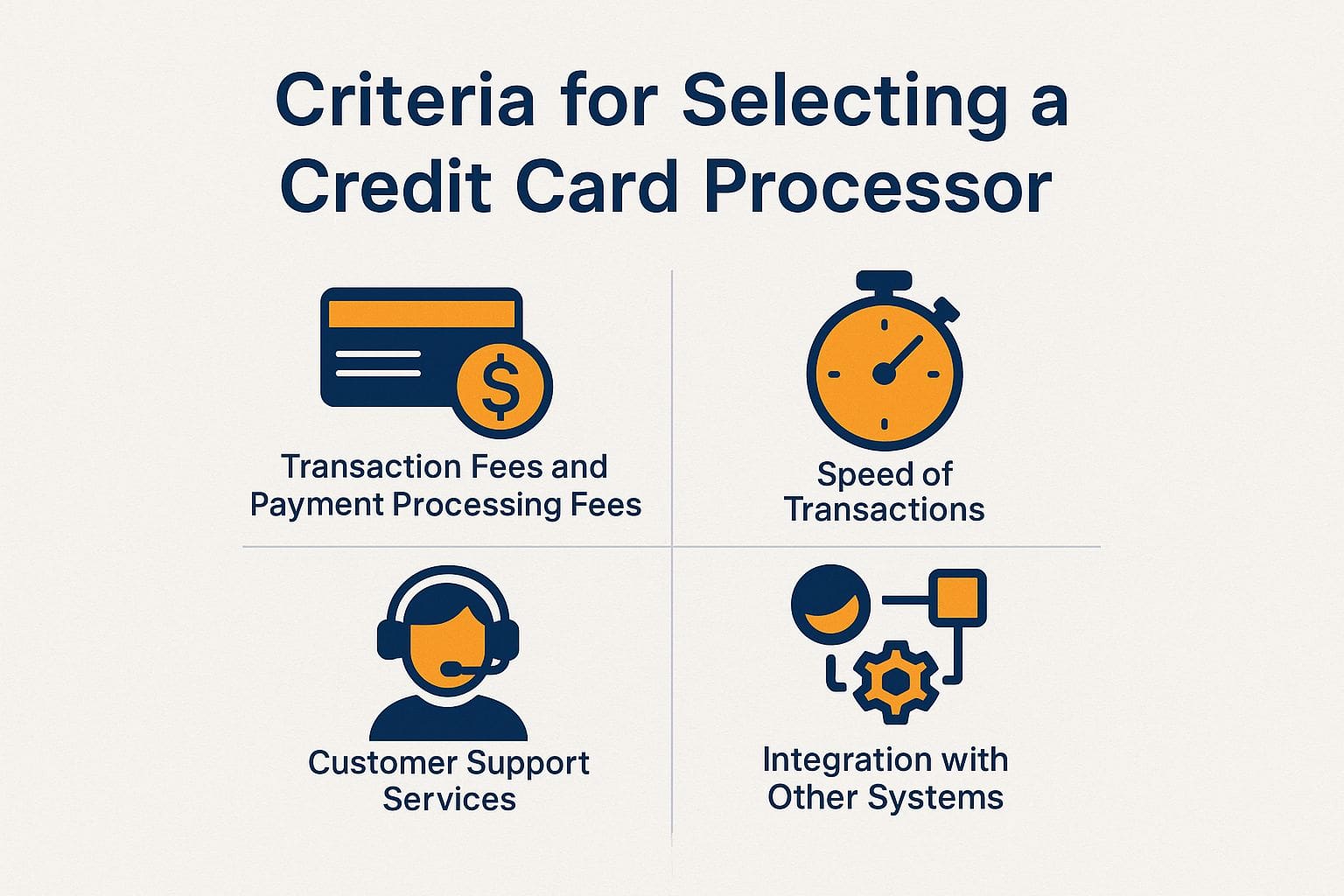
Transaction Fees and Payment Processing Fees
Transaction fees can vary significantly among credit card processors, impacting your profit margins and overall business expenses.
To choose the right processor, consider key factors such as fee structures and ease of integration with your existing systems.
For instance, PayPal charges a flat rate of 2.9% + $0.30 per transaction, which can be advantageous for smaller businesses. Square has a simple rate of 2.6% plus $0.10 per transaction, which is great for retail businesses. On the other hand, processors like Stripe use interchange-plus pricing, which can save money for businesses with large sales.
Look at your average transaction size to find the setup that best reduces your fees, making your costs and service charges lower.
Speed of Transactions
The speed at which transactions are processed can affect customer satisfaction, cash flow management, and payment speed for your business.
For instance, PayPal typically processes transactions within 3-5 business days for standard transfers, while Square offers almost instant payments, often settling within minutes. This difference can significantly impact cash flow.
If you rely on fast funds, Square may be preferable, especially for businesses needing quick access to revenue.
Consider transaction fees; Square charges 2.6% + 10c per transaction, while PayPal’s fees can vary based on the account type and volume.
Evaluate your business’s specific needs and transaction patterns to choose the right processor.
Customer Support Services
Good customer support is key when handling payment processing problems, payment integration issues, and maintaining service reliability.
To evaluate support options, look for processors that offer various channels. For instance, Stripe provides 24/7 phone support and live chat, boasting an average response time of under five minutes.
In comparison, Authorize.Net offers email and chat support, but users report slower response times of around 24 hours.
Think about what you like-do you need help right away or can it wait-and check how happy users are, as reviews often mention important moments when things aren’t working. Choosing wisely can greatly improve how effectively you run your operations.
Integration with Other Systems
It’s important that your selected payment processor fits well with your existing systems to achieve the best outcomes.
To make sure they work well with e-commerce platforms like Shopify and WooCommerce, look at payment processors that provide detailed API documentation and payment technology infrastructure and help for developers.
Stripe offers a simple API and detailed setup guides, which make it easy to install on both platforms. PayPal provides detailed documentation and has a team focused on helping with integration.
When choosing a processor, think about the transaction fees and how easy it is to reach customer support. This will make setting up easier. This approach improves user experience and helps business expansion.
Overview of the Top 9 Credit Card Processors
The field of credit card processing offers different solutions suited to businesses of all sizes, from new companies to big corporations. To help you choose the best option, consider exploring our comprehensive guide on which credit card processor is best for your business.
1. Square
Square is a popular choice for small businesses, offering an all-in-one payment processing solution with no monthly fees.
With Square, businesses benefit from a free point-of-sale app that simplifies transactions, charging only 2.6% + $0.10 per transaction. It is important to note that it functions well with popular e-commerce platforms such as Shopify and WooCommerce, providing flexibility.
For example, a local cafe can easily set up online ordering through Shopify, allowing customers to place orders from home. User reviews often commend Square for being easy to use, especially for new business owners learning digital payment systems. It’s a great option for those looking for smooth operations.
2. PayPal
PayPal remains a leader in digital payment processing, known for its strong buyer protection policies and global reach.
With a transaction fee structure of 2.9% plus $0.30 per sale, PayPal is competitive while supporting seamless integration with online stores like Shopify and WooCommerce.
Users appreciate the ability to accept various payment methods, including credit cards and bank transfers, all via a single platform.
PayPal also excels in mobile payments, allowing businesses to cater to customers on the go. Recurring billing features let businesses manage subscriptions easily, providing a dependable choice for entrepreneurs who want to make their online sales system simpler.
3. Stripe
Stripe is popular with businesses knowledgeable in technology because of its strong API and ability to offer different payment processing options.
The pricing is simple: a transaction fee of 2.9% plus $0.30 for each transaction, which is attractive to new businesses.
Businesses can easily customize their checkout experience using Stripe’s extensive documentation and API capabilities. Integration is seamless with various e-commerce platforms like Shopify and WooCommerce.
Companies like Lyft use Stripe to process millions of payments every day, showing its reliability. Stripe helps businesses accept payments from around the world, allowing them to grow internationally without complicated challenges.
4. Authorize.Net
Authorize.Net is a trusted payment gateway that has been in the industry for over 20 years, providing reliable service to merchants.
With a setup fee roughly $49 and a monthly charge of $25, Authorize.Net offers solutions for detecting fraud and options for recurring billing, making it a solid choice for online companies.
To use these features, merchants can effortlessly connect the gateway with shopping carts like WooCommerce or Shopify. This integration makes payments easier, which makes things better for customers and helps business transactions.
Businesses can monitor transactions using a user-friendly dashboard, which aids in handling finances, analyzing customer actions, and tracking activities.
5. Clover
Clover provides a complete point-of-sale system with hardware and software designed for retail and service businesses.
With pricing starting at $14/month, Clover provides flexible hardware options like countertop terminals, mobile devices, and self-service kiosks.
Notably, the Clover Mini and Clover Station are popular for their versatility and ease of use. Businesses can customize the software with features such as inventory management and loyalty programs and subscription payments.
For instance, a local coffee shop using Clover reported a 25% increase in sales after implementing a loyalty program, showcasing its impact on business growth and customer retention. Other examples show that Clover can increase efficiency and make customers happier.
6. Braintree
Braintree, a PayPal service, specializes in mobile payment processing and is ideal for businesses with a strong mobile presence, enabling mobile payments and contactless payments.
Its powerful features include transaction processing fees of 2.9% plus $0.30 per transaction and support for various payment methods like Venmo and digital wallets.
For example, popular apps like Uber and Airbnb rely on Braintree for seamless, user-friendly payment experiences.
To begin, use Braintree’s detailed API documentation which helps you set up integration, improving your app’s payment features quickly.
With a dedicated support team, businesses can quickly solve problems, improving their payment process.
7. WorldPay
WorldPay is a global leader in payment processing, supporting businesses with diverse international payment needs.
WorldPay provides a strong pricing plan designed for businesses of different sizes, offering reliable payment gateways. For instance, their small business plan starts at around 2.75% per transaction, which suits startups processing fewer payments.
For larger enterprises, they provide customized pricing that can include multi-currency support and fraud protection, ensuring secure international payments worldwide.
WorldPay commands a 25% market share in the UK, powering over 400,000 businesses. Their extensive reach demonstrates they are trustworthy and capable in handling complex payment systems effectively.
8. Fattmerchant – Flexible Payment Solutions
Fattmerchant provides a subscription pricing model that helps businesses save on processing fees as they expand, offering flexible payment options.
For just $99 monthly, Fattmerchant provides an array of features beyond simple payment processing, including advanced payment processing software. This includes built-in analytics for monitoring sales results, tools for managing customer relationships, and no transaction fees, letting businesses retain more of their income.
Users can access customized reports to see transaction trends and use payment analytics to make better decisions. To get the most out of it, businesses should connect Fattmerchant with accounting software like QuickBooks or Xero. This helps manage finances easily and cuts down on administrative tasks.
9. Adyen
Adyen is recognized for offering full payment services suitable for large companies, which makes it ideal for big businesses looking for a single method to handle payments.
Adyen’s fees are typically based on transaction volume and vary by region, which enables scalability for different business sizes, supporting diverse revenue streams.
For example, major brands like Uber and Spotify use Adyen to handle payments in different currencies, improving their worldwide presence.
By utilizing its multi-currency capabilities, businesses can localize payment options, reducing cart abandonment rates and facilitating cashless transactions.
Adyen’s single system makes it easier to handle reports and balance the books, providing detailed information on transaction data that helps improve sales plans. This integrated approach can significantly increase operational efficiency.
Comparative Analysis of the Processors
A study comparing major credit card processors highlights clear differences in transaction speed, costs, and ease of use, showing how payment methods vary across platforms.
Transaction Speed Comparison
Knowing how fast transactions are processed helps businesses reduce wait times and keep customers happy.
Different processors have varying transaction times due to their processing methods and bank partnerships.
Square processes payments immediately, which is perfect for quick transactions. PayPal typically takes 1-3 days, allowing time for fraud checks and fund transfers, while Stripe’s speeds range from 2-7 days, factoring in bank clearance times.
Businesses should choose a processor based on their operational needs, considering that faster processing can improve cash flow but may incur higher fees.
Checking how long each process takes helps make payment strategies more efficient.
Fee Structures Overview
Each credit card processor has its own fee structure, which can significantly impact your overall costs.
To compare the top processors, consider their fee types: flat-rate, transaction, and monthly costs.
For instance, Square charges 2.6% + 10c per transaction, while PayPal has a similar rate but includes a monthly fee of $30 for business accounts.
Stripe, on the other hand, charges 2.9% + 30c per transaction with no monthly fee.
By negotiating fees with your chosen provider, you could save hundreds annually, especially if you process high volumes. Always assess these structures based on how many transactions you process to find the most suitable option.
User Experience, Interface, and Payment Ecosystems
A smooth user experience, integrating user interface improvements, can increase customer happiness and lead to repeat business.
To make your website effective, pay attention to these three important areas: design, how it works, and how fast it is.
Start by choosing a clean design template that aligns with your brand. Tools like Canva can help you customize graphics easily.
Next, evaluate how the website works by trying out features like moving through pages and checkout steps; think about using Hotjar to collect opinions from users.
Make your site faster by improving images and using caching tools like W3 Total Cache. These steps can significantly improve user engagement and retention, driving repeat visits.
Final Recommendations
Businesses that want something simple will like Square, while larger companies might prefer Adyen because it offers many fintech solutions.
Square charges a simple fee of 2.6% for card transactions without any monthly fees, which is suitable for small businesses or new companies, particularly those requiring point-of-sale systems.
Unlike others, Adyen provides flexible options for big businesses, such as the ability to tailor payment processes and handle different currencies, with transaction costs that adjust according to the amount of business. A medium-sized online store might pick Square because it’s easy to set up, while a global company might prefer Adyen to handle international transactions smoothly.
Both platforms support various payment methods, ensuring flexibility for different customer preferences.
Future Trends in Credit Card Processing
New technologies and shifting customer preferences are influencing how credit card processing and financial technology will work in the coming years.
More people are using digital wallets and contactless payments because they want easier ways to pay. For instance, platforms like Apple Pay and Google Wallet facilitate quick transactions, leading to longer customer retention.
Progress in fraud prevention, like AI-based checking of transactions, helps sellers cut down on losses and increase customer confidence. Over the next five years, merchants can expect a 30% increase in digital payment adoption, necessitating investment in compatible systems (our 2025 benchmark guide on credit card processing rates offers further insights).
Keeping up with these trends will help you stay competitive in a fast-changing market.
About The Author
Jordan Blake is a B2B strategist and contributor at Price It Here, where she shares expert advice on buying decisions and business growth. She holds a Bachelor’s in Business Administration from the University of Michigan and an MBA from Northwestern’s Kellogg School of Management.
With over a decade of experience in procurement and vendor strategy, Jordan helps businesses save money and scale smarter. Her practical insights make her a trusted voice for entrepreneurs seeking cost-effective, results-driven solutions.
