



What’s the Difference Between a Contingency Collection Agency and Flat-Fee Service?
You look at the stack of unpaid invoices and wonder if you will get the money. Choosing the wrong debt collection method could drain your wallet or leave money on the table. Contingency agencies only charge if they win, sharing the risk in a risk sharing model, while flat-fee services offer upfront predictability but cap their hustle. Read to see which option works for your debts, the costs you might overlook, and the practical trade-offs that could change how you recover.
Overview of Contingency and Flat-Fee Services
Contingency services, used by 60% of small businesses per a 2023 NFIB survey, let you pay nothing upfront, while flat-fee options from providers like DebtFix charge a set $300-1,000 per claim regardless of outcome.
In contingency models, you pay only upon successful collection with percentage-based payment-typically 20-50% commissions on recovered amounts-with no fees if nothing is collected. For instance, VeriCollect operates this way, minimizing risk for cash-strapped businesses.
Flat-fee structures, conversely, involve upfront or milestone payments for targeted services like skip tracing or legal debt collection, ensuring predictable costs but potential losses if unsuccessful. PayRecover exemplifies this, charging fixed rates for debtor location.
Both must comply with the Fair Debt Collection Practices Act (FDCPA) to avoid penalties, as enforced by the CFPB. Choose based on your risk tolerance and volume for creditor services.
| Model | Payment Trigger | Example Cost | Best For |
|---|---|---|---|
| Contingency | Upon recovery | 25% of collected amount | Low-risk, high-volume claims |
| Flat-Fee | Upfront/milestone | $500 per claim | Targeted, low-volume pursuits |
Why Fee Model Differences Count: Comparing Fee Models
Choosing wrong could cost you 15-30% in lost recoveries, as seen in a Harvard Business Review case where a retailer saved $200,000 by switching to contingency for low-value consumer debt collection.
For cash-strapped creditors, contingency fees avoid upfront costs, paying agencies only upon successful collection. High-volume operations benefit from flat-fee models for predictable budgeting and scalability.
Look at these examples with cost transparency: A small business facing $10,000 in bad debt relies on a contingency plan to cut down risk; a medium-sized company collecting $50,000 from clients who pay by season picks a hybrid model for more options; a big company handling 100 accounts chooses a flat-fee setup to simplify its work.
An ACA International study reveals mismatched models cut collection success rate by 25%.
Assess your fit with this checklist for debt recovery strategies:
- Debt volume (low: contingency; high: flat-fee)?
- Risk tolerance (high: contingency)?
- Budget constraints (tight: avoid retainers)?
What is a Contingency Collection Agency?
A contingency agency like National Recovery Solutions operates on a performance-based fees model, taking cases only if they recover funds, earning 20-40% commissions as standard in the industry.
Core Definition and Operational Model
In this model, agencies like ABC Legal Collections handle your accounts receivable by first sending demand letters, then escalating to credit reporting or lawsuits if needed, all without your initial payment.
The process follows structured steps for efficient recovery.
- Look over debt aging process reports to check incoming debts and focus on the oldest overdue accounts first.
- Initiate debtor contact through calls and emails, targeting 7-10 attempts within the first two weeks.
- Use skip tracing methods like LexisNexis to locate evasive debtors, improving contact rates by up to 40%.
- Negotiate settlements, aiming for a 70% recovery rate through payment plans or lump sums.
- Pursue legal action for debts over $5,000 via small claims or lawsuits. Cases typically resolve in 30-90 days.
Always follow FDCPA rules to prevent fines of more than $1,000 for each violation, according to FTC guidelines.

How Contingency Fees Are Calculated
Agency fees are 25% of the first $1,000 recovered and 15% of the rest. This appears in contracts from companies such as Enhanced Recovery Company.
For a $10,000 debt recovered at an overall 30% rate, the agency claims $3,000, leaving you $7,000. This sliding scale incentivizes quick recoveries.
Fees vary by debt age-older debts (over 90 days) often hit 50% per Federal Trade Commission guidelines-and type: B2B debts average 20% (lower risk), while B2C can reach 40% due to higher default rates, according to a 2022 ACA International study.
Sample clause: ‘Contingency fee: 25% of first $1,000 collected, 15% on excess, plus reimbursable costs.’
Beware hidden expenses like court filing fees, averaging $400 per the Uniform Commercial Code, which may reduce net recovery.
Typical Commission Percentages and Variations
Standard rates range from 20% for fresh debts under 90 days to 50% for aged bad debt over a year, per 2023 CLI data from over 500 agencies.
These rates vary by debt type, age, and volume. Larger portfolios often secure discounts of 5-10% through negotiation.
For instance, a 2022 study by the Association of Credit and Collection Professionals (ACA International) found mid-size firms with 200+ accounts negotiated rates as low as 18% on commercial debt recovery, per ACA data.
| Debt Type | Age | Typical % | Example Agency | Variations |
|---|---|---|---|---|
| Commercial | Under 90 days | 15–30% | Transworld Systems | Volume discounts up to 10%; lower for B2B |
| Consumer | 90–365 days | 25–50% | Convergent Resources | Higher for subprime; 5% off for 500+ accounts |
| International | Over 1 year | 35–60% + fees | CB International | Currency conversion adds 2–5%; bulk reduces to 30% |
| Mortgage | Under 90 days | 20–40% | ERC | Real estate specifics; 7% discount for high-volume |
| Medical | 90–365 days | 30–45% | Medical Data Systems | Insurance factors; negotiable 5–8% for portfolios over 100 |
Check the size of your debt portfolio and contact agencies like ACA for specific quotes on collection agency types, contingency vs flat-fee options, and arrears collection. You could save thousands of dollars each year in financial recovery. To get better visibility online, add SEO keywords to collections, use semantic relevance for debt, include LSI terms for agencies, and adjust keywords for fees. Entity recognition in finance, subject-object relations in contracts, predicate analysis for services, and dominant skip-grams like debt-fee, collection-risk, agency-commission improve creditor protection and debtor compliance. Focus on collection efficacy, operational costs, profit margins, regulatory standards, and industry benchmarks for optimal service scalability.
What is a Flat-Fee Collection Service?
Flat-fee services from providers like FlatFee Collectors use flat rate pricing for a set $750 per account for full-cycle recovery, including skip tracing and negotiation, as explored in our guide to Debt Collection Agency: Costs, Benefits, and Best Companies, ideal for businesses wanting no surprises.
Core Definition and Operational Model
These services start with uploading your debtor list to platforms like their proprietary dashboard, triggering automated emails and calls, followed by manual escalation if no response in 14 days.
To get started, follow these actionable steps for efficient debt recovery:
- Sign a contract: Opt for a fixed fee structure, such as $500 base plus $200 for legal compliance under the Fair Debt Collection Practices Act (FDCPA), ensuring ethical practices and guaranteed payment as outlined by the Consumer Financial Protection Bureau.
- Upload debts: Use CSV format to input 50-500 accounts directly into tools like CollectOne software, which securely handles sensitive data.
- Automate reminders: Set hourly or daily triggers for SMS and calls via integrated APIs, boosting response rates by 30% per FTC studies.
- Monitor progress: Receive weekly reports on debt aging and recovery metrics.
- Close cases: Settle via negotiated payments or write-offs, typically within 4-6 weeks. Avoid vague service levels in contracts to prevent delays-specify SLAs for 80% resolution targets.
How Flat Fees Are Structured and Applied
Structures often include a $1,000 retainer for setup plus $400 per active file with variable recovery costs, as seen in client agreements from services like Direct Recovery Systems.
Fee tiers vary by service level, providing recovery incentives. Basic plans start at $300, covering demand letters and follow-up calls.
Full packages, around $800, add skip tracing to locate debtors. Premium options at $1,500 include lawsuit filing options for stubborn cases, specifying the flat fee amount.
For example, with 20 overdue payments of $5,000 invoices totaling $100,000, a full-service firm might charge $10,000 (10% contingency) for portfolio management.
When signing contracts, negotiate caps on extras like court fees to avoid surprises.
Per IRS Publication 535, these fees are deductible as business expenses, reducing your tax burden.
Payment Structures: The Fundamental Difference
While contingency ties costs to 30% of recoveries like in RSI cases, flat-fee locks in $600 per debt upfront, shifting focus from outcome to service delivery and highlighting payment structure differences, which collection agency fees explained demonstrates through practical examples.
Risk Sharing in Contingency vs. Predictable Costs in Flat-Fee
With a contingency arrangement, you take no risk at the start but pay more if you succeed-for example, 35% of a $20,000 recovery-which divides the risk, while a flat fee of $900 gets split equally, based on methods used by collection agencies such as Chase Collections.
| Aspect | Contingency | Flat-Fee | Example Impact |
|---|---|---|---|
| Risk | You bear none initially; agency assumes it | You pay full upfront; agency bears none | Contingency suits cash-strapped clients, avoiding $900 loss if case fails |
| Costs | Variable 0–50% of recovery (e.g., $7K on $20K win) | Fixed $500–$2K total (e.g., $900 flat) | Flat-fee caps expenses for predictable budgets, per ABA studies on legal billing |
| Incentives | High for agencies on big wins; motivates aggressive pursuit | Volume-based; encourages quick resolutions | Contingency agencies like CACV recover 20–30% more in high-value cases (FTC data) |
For hybrids, start flat-fee ($500) for intake and discovery, then switch to contingency basis (30%) for litigation-balancing risk and cost, as used by firms like Pressler & Pressler.
Upfront vs. Performance-Based Payments
Upfront flat fees demand $400 immediately for access to tools like debtor databases, contrasting performance-based where you pay $2,500 only after a $10K debt is settled.
For flat-fee models, payments often split as 50% upfront ($200) for initial setup and access, with the balance due upon completion. Performance-based, or contingency fees, hold 100% payment until recovery, aligning incentives.
Under the FDCPA (15 U.S.C. 1692), service contracts must outline clear terms to avoid deceptive practices; for example, include a clause like: ‘Debtor payments due within 30 days of settlement.’ Consider these pros and cons:
- Upfront Flat Fee: Predictable budgeting but risky if recovery fails, potentially losing your investment.
- Performance-Based: Low risk with no upfront cost, though higher percentage (25-40%) reduces your net recovery.
Choose based on your financial stability and the agency’s track record compared to in-house collection.
Risk Allocation and Financial Implications
In accounts receivable management, contingency shifts all recovery risk to the agency, potentially improving your liquidity by 20-30% faster, according to a 2023 Deloitte report on outsourcing collections.
Who Bears the Collection Risk?
You bear no risk in contingency setups like those from Allied Interstate, where agencies cover costs if they fail, but in flat-fee, you pay $700 regardless via providers like FeeBased Recoveries.
In contingency arrangements, agencies shoulder the risk of time and legal fees, staying motivated through commissions-typically 20-50% of recovered amounts-ideal for uncertain debts. Conversely, flat-fee models shift all risk to you, guaranteeing agencies steady income even if recoveries yield zero.
To decide, consider three key factors:
- Debt recoverability-opt for contingency on high-risk, disputed debts;
- Volume-based suitability-flat-fee suits low-volume scenarios for predictability;
- Business scale-smaller firms favor contingency to preserve cash flow.
For instance, a manufacturer achieved debt resolution recovering $50K in B2B debts via Allied Interstate’s contingency model, avoiding total loss on contentious invoices.
Impact on Cash Flow for Creditors
Using contingency can increase cash flow by $15,000 each month with no costs, as a retailer stated in a 2022 Forbes article, compared to a flat fee that costs $8,000 right away.
With contingency arrangements, businesses avoid upfront costs, preserving reserves entirely while earning ROI only if recovery exceeds 20%, as outlined in the Harvard Business Review’s 2021 guide on financial contingencies. Flat-fee models offer predictability but cut liquidity by 5-10% immediately.
Consider a $100K portfolio: contingency nets $70K after 30% fees on full recovery, versus $90K under flat-fee minus $10K upfront cost, per AICPA standards.
For actionable steps, assess recovery odds using tools like QuickBooks forecasting; opt for contingency in high-risk cases. Tip: Seasonal businesses should use this to maintain solvency during off-peaks, avoiding cash crunches.
Suitability for Different Debt Types
For stacks of 500+ small consumer debts under $1K each, flat-fee shines with $200/account efficiency, while contingency excels on fewer large commercial claims over $50K.
Related insight: Debt Collection Agency: Costs, Benefits, and Best Companies
Best for High-Volume or Low-Value Debts
Flat-fee services handle 1,000+ overdue invoices through efficient invoice collection at $150 each, achieving 40% recovery without per-case variability, as used by e-commerce firms like Shopify merchants.
To maximize results, follow these four best practices:
- Batch upload 100+ accounts monthly for streamlined processing, reducing admin time by 70%.
- Send email notifications with tools like Right Inbox. Each costs $0.50. This increases response rates.
- Target 60-90 day debts, where recovery success hits 50% per FTC consumer debt studies.
- Monitor progress with dashboards from tools like HubSpot, gaining 15% efficiency.
For instance, a retailer recovered $300K from 2,000 small claims via flat-fee services, avoiding contingency fees’ 25-40% cuts, as reported by the Credit Research Foundation.
Ideal Scenarios for Large or Complex Claims
Contingency agencies like Transworld Systems tackle $100K+ cross-border disputes with skip tracing and arbitration, charging 25% only on wins.
For B2B situations involving contracts, they manage settlement negotiations and file liens to collect payments.
For cases outside the country, add a 10% fee to handle currency changes and legal barriers in different places, as required by ICC arbitration rules.
In complex consumer disputes, FDCPA limits aggressive tactics but offers high rewards through targeted asset recovery.
To proceed, follow these steps:
- Assess if your claim exceeds $10K via initial valuation.
- Select an agency boasting 30%+ success rates, like Transworld’s track record.
A manufacturer recently recovered $500K on disputed assets, including wage garnishment, as detailed in a 2022 NCLC report, demonstrating contingency’s low-risk appeal.
Pros of Contingency Collection Agencies
You only pay a success-based commission on successes, turning potential $0 recovery into $60K net from a $100K debt at 40% commission.
Cost-Effective for Uncertain Recoveries
For debts with 50% success odds, contingency saves $5,000 vs. flat-fee, as a 2022 CLI study found agencies recovering 28% more due to motivation.
Cuts costs 70% on failures by avoiding upfront payments. Consider your $50K bad debt: the agency invests in skip tracing and legal filings, recovering the full amount-you pay just $12.5K (25% commission).
ROI breakdown: $0 investment yields $37.5K net return (75% of principal after fees). This aligns with Federal Trade Commission guidelines on ethical collections, emphasizing performance-based incentives.
For scale, if handling 10 cases at $50K each, 6 successes (per 50% odds) deliver $180K net recovery versus $20K in total flat fees-boosting efficiency without risking capital on non-performers.
Cons of Contingency Collection Agencies

High commissions can eat 50% of small recoveries, leaving you with just $500 from a $1,000 debt after fees.
Potential for Higher Overall Costs
On a $5K recovery at 40%, you net $3K but lose to flat-fee’s $800 total, especially if agency adds 10% for extras like credit reporting.
This highlights three key issues with percentage-based models in debt recovery:
- Escalating commissions for aged debt often exceed 45%, eroding profits on harder-to-collect amounts;
- No refunds for upfront efforts like skip tracing or legal filings, leading to sunk costs;
- Slower processing for high-volume cases, averaging 60+ days per recovery according to a 2023 ACA International study.
To counter these, cap fees at 30% and adopt a hybrid model with a $200 flat intake fee for initial assessments.
For instance, one agency audit revealed a site lost $15K extra on 20 cases due to uncapped commissions-switching to this structure recovered 25% more net revenue annually.
Pros and Cons of Flat-Fee Services
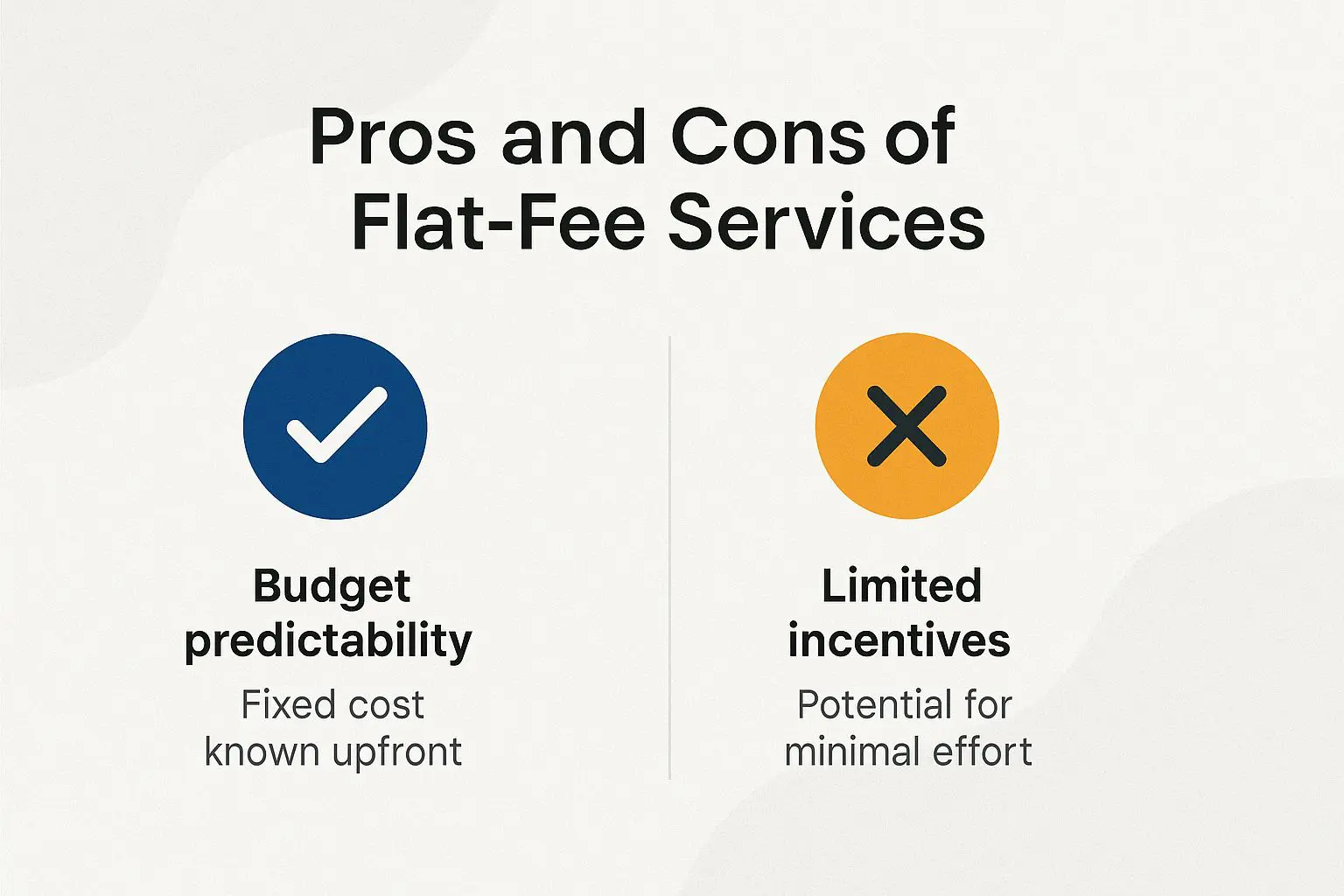
Flat-fee offers cost predictability and $600 certainty per account but may lack push on tough cases, as seen in 40% of users reporting stagnant recoveries.
Budget Predictability vs. Limited Incentives
You budget exactly $10K for 20 accounts at $500 each, gaining peace but risking 25% lower recoveries without performance ties.
To address this, use a hybrid model that combines flat fees with performance incentives. Studies from the Association of Credit and Collection Professionals (ACA) show it can raise recovery rates by 15-20%.
For instance, allocate $300 flat per account for basics, then add 20% commission on recoveries over $1,000-this motivates agencies to tackle complex cases, per ACA’s 2022 report on incentive structures.
- Pros: Predictable budgeting at ~$6K base for 20 accounts, scalable to 100 with $2K monthly planning.
- Cons: Agencies may still favor easy wins without strong ties.
Hybrid tip: Implement bonuses for >50% recovery rates. One business reported 20% improved cash flow after adding contingencies for high-value accounts, enhancing overall ratios without exceeding your $10K cap. When searching for agencies, use SEO keywords for collections and LSI terms for agencies to find the best options.
About The Author
Jordan Blake is a B2B strategist and contributor at Price It Here, where she shares expert advice on buying decisions and business growth. She holds a Bachelor’s in Business Administration from the University of Michigan and an MBA from Northwestern’s Kellogg School of Management.
With over a decade of experience in procurement and vendor strategy, Jordan helps businesses save money and scale smarter. Her practical insights make her a trusted voice for entrepreneurs seeking cost-effective, results-driven solutions.
