



Low-Fee Credit Card Processing: What Every Small Business Should Look For
Think about increasing your earnings and making your customers happier-sounds like a dream, doesn’t it? For small businesses, knowing about low-fee credit card processing is important for achieving this balance. You’ll learn why these fees matter, what types there are, and important things to think about when choosing a processor. Find out how to steer clear of typical mistakes and gain the advantages of low-cost choices. Learn how the right decision can improve your business!
Importance for Small Businesses
For small businesses, reducing the cost of credit card fees means more money can go towards expansion efforts, making affordable credit card processing and merchant services very important.
Consider a local caf that processes $100,000 annually in credit card sales. If their previous credit card processor charged 3% fees, they were losing $3,000 each year.
By switching to a provider with a 1.5% fee, their costs dropped to just $1,500, saving $1,500 annually. This new capital could fund marketing campaigns or hire additional staff.
Utilizing tools like Square or PayPal allows businesses to analyze their fee structures, offering integration options and user-friendly interfaces, and select an option that aligns with their financial goals, further enhancing profitability.
Overview of Credit Card Processing Fees
Credit card processing fees often include hidden costs. These fees can vary significantly between different providers.
These components often include transaction fees, monthly fees, setup fees, and chargeback fees.
For example, transaction fees are often 2% to 3% of each sale, which is important for planning your budget. Some providers may charge a flat monthly fee (around $20) alongside these transaction costs. Chargeback fees-which average $15 to $25-apply if a customer disputes a charge.
When choosing a processor, make sure to look at their fee structure closely, consider the payment gateway options, and ask for a detailed list of costs to avoid any surprises.
A Clear Look at Credit Card Processing Fees
Knowing the different types of credit card processing fees is important for small business owners who want to improve their payment processing methods and maintain compliance standards. For those looking to deepen their understanding, our guide provides detailed insights into these fees and how they impact your business.
Types of Fees Involved
There are different fees related to credit card processing, such as interchange fees, assessment fees, and markup fees.
Interchange fees, typically ranging from 1.5% to 2.5%, are charged by card networks each time a transaction occurs. These funds compensate the cardholder’s bank.
Assessment fees are generally lower, around 0.1% to 0.15%, covering the network’s administrative costs. Markup fees are the service charges imposed by payment processors, often varying based on your contract.
Knowing these fees is important; for example, talking to your provider about reducing markup fees can help a small business save hundreds of dollars each year.
Interchange Fees Explained
Interchange fees are fees that merchants pay to card-issuing banks and are often the largest component of credit card processing costs.
For example, Visa’s average interchange fee typically hovers around 1.5%, whereas debit card fees are generally lower, often ranging from 0.5% to 0.8%. Knowing these fees helps in managing costs and improving transaction speed. The fees depend on the type of card, as well as the risk and how the transaction is processed.
Merchants can manage these costs by using payment processors like Square or PayPal, which offer transparent pricing structures. Negotiating terms with your payment provider can also yield better rates, especially for high-volume sales.
Make sure to check your monthly statements for mistakes and look into choices that fit your business plan.
Assessment Fees and Markup
Fees from card networks such as Visa and Mastercard are called assessment fees, and payment processors charge additional fees for their services.
For example, Visa charges an assessment fee of 0.11% on each transaction, meaning that for a $100 sale, the fee would be $0.11.
Unlike banks, payment services such as Square and PayPal usually add their own extra charges. Square’s fees are 2.6% plus 10 cents, while PayPal charges 2.9% plus 30 cents.
This means that if you process a $100 payment through PayPal, you’d pay $3.20 in total, including both the assessment and markup fees.
Knowing these differences helps businesses plan their expenses and choose the right payment processing option.
Factors to Consider When Choosing a Processor
Choosing the right credit card processor involves evaluating key elements that can significantly affect your business’s earnings. For an extensive analysis of options available, our guide on choosing the best credit card processor for your business offers in-depth insights.
Fee Structures: Flat Rate vs. Tiered
Knowing the difference between flat rate and tiered fee structures is important for estimating your total processing costs.
Flat rate processors, like Square, charge a clear fee of 2.6% plus 10c per transaction, which is good for businesses with consistent sales. This simplicity allows for easy budgeting.
In contrast, tiered processors, such as Authorize.Net, have different rates for qualified, mid-qualified, and non-qualified transactions. This can benefit businesses with fluctuating sales and high-ticket items, but may lead to unpredictable charges.
Look at your sales patterns: if you often have small and steady sales, a flat rate is better. For larger, varied sales, tiered may save you money.
Contract Length and Terms
When selecting a payment processor, be mindful of contract length and terms, which can lock you into unfavorable conditions affecting business operations and cash flow management.
Common contract lengths range from one to three years, with varying termination fees that can significantly impact your costs. For instance, First Data may impose a fee of up to $495 if you terminate early, while PayPal typically has no long-term contracts but may charge fees for account closure.
Always read the fine print and consider opting for month-to-month agreements if possible. Checking how fast transactions are handled and how well customers are treated can help you choose what suits your business over time.
Customer Support and Service
Strong customer support can greatly help with handling payment processing problems and reducing downtime.
For instance, look for payment processors like Stripe, Square, and PayPal, which offer around-the-clock support, strong customer support, and quick response times.
Stripe offers a large collection of online documents and live chat to quickly solve problems. Square provides phone support during business hours, while PayPal offers a community forum for diverse inquiries.
When evaluating these services, consider metrics like average response time and availability of multiple support channels, as these can greatly impact your business continuity in times of need.
Evaluating Low-Fee Processing Options
To find the cheapest way to process payments, compare different providers closely. This approach has significant implications for your business-our comprehensive guide on which credit card processor is best demonstrates the practical application.
Comparing Multiple Providers
When comparing payment processors, create a comparison chart that includes key metrics such as fees, features, and contract terms.
To effectively evaluate payment processors, consider these five options:
- Square: No monthly fee; transaction fees are 2.6% + 10c per swipe.
- PayPal: Free for personal accounts; charges 2.9% + 30c per transaction for standard services.
- Stripe: 2.9% + 30c per transaction; no setup fees, ideal for developers.
- Authorize.Net: Monthly fee of $25; transaction rates at 2.9% + 30c, suited for established businesses.
- Shopify Payments: No additional fees if using Shopify; transaction fees start at 2.9% + 30c with a basic plan.
Choose based on your transaction volume and specific business needs to maximize cost-effectiveness.
Hidden Fees to Watch Out For
Hidden fees can greatly increase your payment processing expenses, so it’s important to spot and know them before agreeing to anything.
- Common hidden fees include chargeback fees, typically ranging from $15 to $25 per occurrence, which can add up quickly if disputes arise.
- Some processors impose statement fees-often around $5 monthly-just for providing transaction summaries.
- Be aware of PCI compliance fees, which may be charged yearly to make sure your business follows security rules. These charges can range from $50 to a few hundred dollars, based on the company.
Always review your agreement carefully and ask for clarifications on any ambiguous charges to avoid surprises.
Benefits of Low-Fee Credit Card Processing
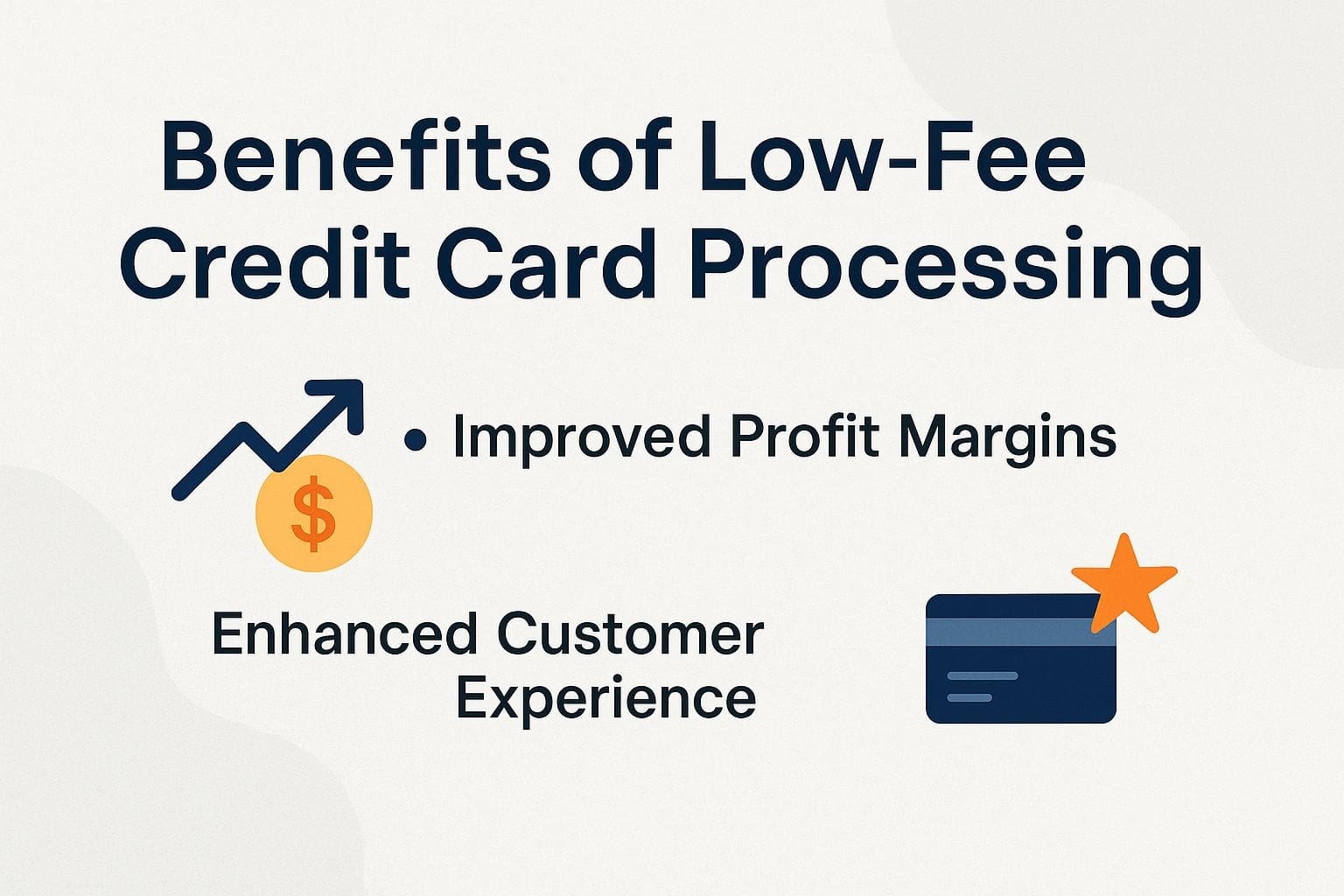
Using low-cost credit card processing can provide great advantages, improving your business’s profits and customer satisfaction through effective transaction management and payment processing. For those curious about how these cost structures impact your operations, our detailed insights on credit card processing costs in 2025 offer valuable guidance.
Improved Profit Margins
Switching to low-fee processing can lead to improved profit margins, directly impacting your bottom line and enabling reinvestment into your business.
For instance, a small coffee shop that reduced its processing fees from 2.5% to 1.5% saved $1,000 annually. By looking at choices such as Square for its lower costs for small businesses, or PayPal for its clear fee setup, you can find ways to save a lot of money.
These changes increase profits and allow you to put money back into things like newer equipment or better customer service. Keeping track of your fees each month helps you find the lowest possible price.
Enhanced Customer Experience
Low-cost processing improves the customer experience by shortening checkout times, improving user experience, and providing clear pricing.
Platforms like Shopify and WooCommerce highlight the importance of seamless payment experiences and effective use of payment processing platforms. Shopify works with more than 100 payment gateways, letting users change options smoothly.
Facilitating features like one-click payments and auto-fill forms, combined with cost-effective solutions, can significantly decrease cart abandonment rates. By offering a variety of payment methods, such as:
- Digital wallets (e.g., Apple Pay, Google Pay)
- Invoicing and installment plans like Klarna
E-commerce sites increase customer satisfaction and drive repeat purchases. Simplifying the checkout process makes customers more loyal, helps retain them, and encourages repeat purchases.
Common Mistakes to Avoid in Payment Processing
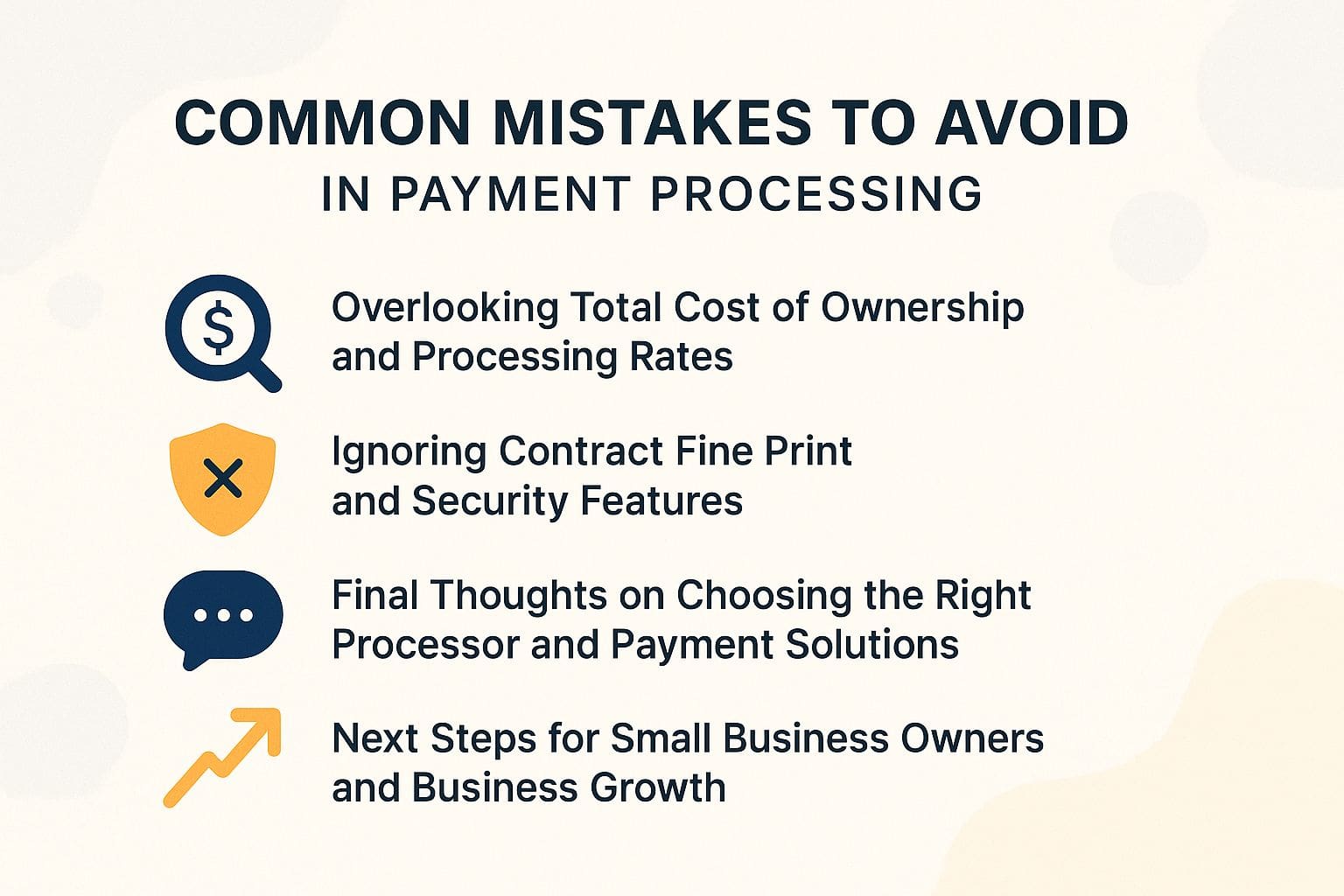
Picking the right payment processor without common mistakes can save your business time and money, making it run more smoothly. For a comprehensive approach, explore how credit card processing machines can enhance financial efficiency and support business growth.
Overlooking Total Cost of Ownership and Processing Rates
Many small businesses overlook the total cost of ownership when selecting a payment processor, focusing only on upfront fees and ignoring processing rates.
To find out your overall cost, add the transaction fees, which usually fall between 2.5% and 3.5% per sale, along with any monthly charges from the processor you select.
For instance, if your business processes $10,000 monthly and incurs a 3% transaction fee, the transaction cost alone would be $300. Add in a hypothetical monthly fee of $30, and your total cost of ownership for that month would reach $330.
Don’t forget to factor in ancillary costs like chargeback fees and chargeback rates, which can vary significantly. This study provides information that supports business decision-making.
Ignoring Contract Fine Print and Security Features
Ignoring the fine print in payment processor contracts can lead to unexpected fees and unfavorable terms.
To avoid pitfalls, focus on key areas including security features and fraud protection.
Look for automatic renewal clauses that could lock you into long terms without a chance to renegotiate. Check for hidden cancellation fees that might arise if you decide to switch processors.
Many contracts also include interchange fees; knowing about these can save you hundreds. Tools like FeeFighter can help you compare various providers while ensuring clarity in their terms.
Carefully reading the material might feel boring, but it can save your business from expensive problems later and help you follow industry rules.
Final Thoughts on Choosing the Right Processor and Payment Solutions
Choosing the right credit card processor is a strategic decision that can influence your business’s long-term success.
Start by evaluating your transaction volume, scalability, and business type, as these factors dictate the ideal processor.
For example, Square is good for small businesses because it has flat-rate pricing and no monthly fees. PayPal is a solid choice for international sales.
Consider factors like customer support, service reliability, and accounting integration with your existing systems; Stripe is excellent for developers due to its customizable API.
Carefully review transaction fees and contracts to avoid unnecessary costs. Aligning these features with your particular needs can make payment processing more efficient.
Next Steps for Small Business Owners and Business Growth
Small business owners should actively review and discuss their payment processing choices to get the best rates, competitive analysis, and service customization available.
Begin by researching various payment processors like Square, PayPal, and Stripe. Compare their transaction fees, monthly charges, and customer service reviews.
For instance, Square charges a flat rate of 2.6% plus 10c per transaction, which can suit businesses with fluctuating sales, aiding in budget management.
Next, reach out to multiple providers to understand potential discounts and custom plans for your business’s size and type. Read contracts carefully to spot any additional fees, ensuring you pick the best choice for your needs.
Resources for Further Learning on Payment Technology and Business Efficiency
For anyone wanting to learn more about low-cost credit card processing and PCI compliance, many resources can offer useful information.
Recommended Blogs and Websites for Payment Methods and User Feedback
Here’s a list of suggested blogs and websites that provide useful information on credit card processing, financial technology, and vendor comparison.
- NerdWallet – Provides detailed reviews and comparisons of credit card processing choices, helping you identify the most suitable fees and features.
- PaymentSource – Focuses on trends in payment processing, providing news and analysis for businesses.
- Merchant Maverick – Examines different payment processors, including detailed comparisons and user reviews.
- The Balance – Provides practical tips on financial technology and payment systems, catering to both businesses and consumers.
- TechCrunch – Regularly covers startup innovations in fintech, highlighting emerging solutions in credit card processing.
These resources will keep you informed on industry trends, technology adoption, and tools.
About The Author
Jordan Blake is a B2B strategist and contributor at Price It Here, where she shares expert advice on buying decisions and business growth. She holds a Bachelor’s in Business Administration from the University of Michigan and an MBA from Northwestern’s Kellogg School of Management.
With over a decade of experience in procurement and vendor strategy, Jordan helps businesses save money and scale smarter. Her practical insights make her a trusted voice for entrepreneurs seeking cost-effective, results-driven solutions.
